What Are AI Marketing Tools?
AI marketing tools are software platforms that use artificial intelligence to help businesses plan, create, automate, and analyze marketing activities.
These tools can support many different areas of marketing.
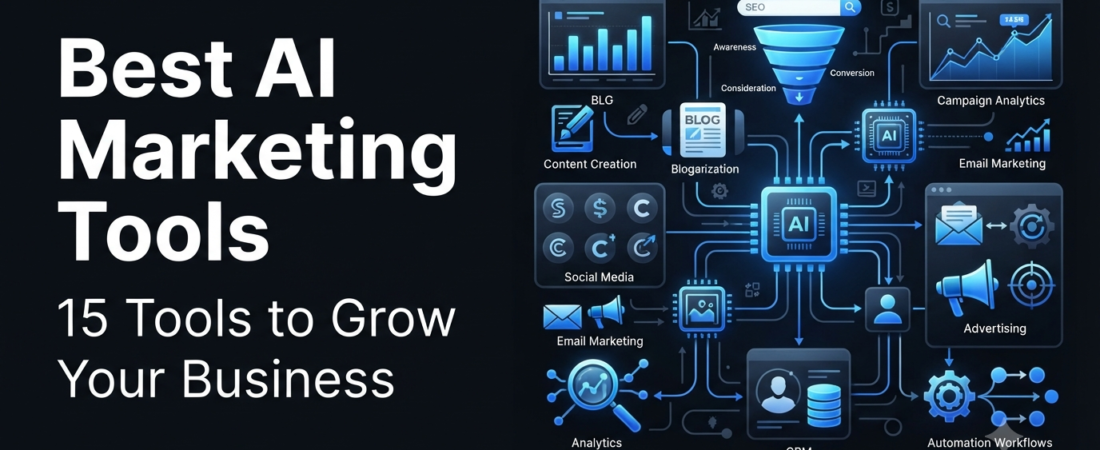
For example, AI can help create content, research keywords, design graphics, write emails, analyze campaigns, manage social media, and automate repetitive marketing workflows.
Modern AI marketing software is therefore much broader than simple AI writing tools. Current marketing platforms cover content creation, SEO, social media, campaign automation, customer engagement, analytics, and creative production.
Why Use AI for Marketing?
Marketing often involves many repetitive tasks.
A marketer may need to research topics, write content, create social posts, prepare email campaigns, analyze performance, and manage multiple platforms.
AI can help reduce the time required for some of these activities.
Save Time
AI can speed up repetitive marketing tasks.
For example, marketers can use AI to generate initial content ideas, summarize research, create variations, or organize information.
Create More Content
AI can help teams produce drafts for blogs, emails, advertisements, social posts, and other marketing materials.
However, human review is still important for accuracy, brand voice, and originality.
Improve Personalization
AI can analyze customer information and help marketers create more relevant messages.
This can be useful for email campaigns, customer journeys, and targeted advertising.
Automate Workflows
AI can work together with automation platforms to connect marketing applications.
For example, a new lead can trigger an AI-generated follow-up message and automatically update a CRM.
If you want to explore this workflow approach, check our guide to AI automation tools.
15 Best AI Marketing Tools
Different marketing tools solve different problems.
Therefore, instead of choosing the tool with the most features, focus on the marketing task you want to improve.
| Tool | Best For | Main Use |
|---|---|---|
| HubSpot | Marketing automation | CRM + marketing |
| Jasper | Marketing content | Brand-focused content |
| Copy.ai | Marketing copy | Content workflows |
| Semrush | SEO | Search research |
| Ahrefs | SEO research | Keywords + competitors |
| Canva | Visual marketing | Graphics and campaigns |
| Buffer | Social media | Scheduling + content |
| Hootsuite | Social management | Social campaigns |
| ActiveCampaign | Email marketing | Automated campaigns |
| Klaviyo | Ecommerce marketing | Email + customer journeys |
| Surfer | Content optimization | SEO content |
| Grammarly | Content editing | Writing improvement |
| AdCreative.ai | Ad creatives | Advertising visuals |
| ChatGPT | Marketing assistance | Research + content |
| Zapier | Marketing automation | Workflow automation |
1. HubSpot
HubSpot provides CRM, marketing, sales, and customer-service tools in one ecosystem.
Its AI features can assist with content, customer engagement, marketing workflows, and other business activities.
Therefore, HubSpot can be useful for businesses that want marketing and customer data connected in one platform.
Best for: Businesses looking for an all-in-one marketing platform.
2. Jasper
Jasper focuses heavily on marketing content and brand consistency.
It can help marketing teams create content for campaigns, websites, advertisements, emails, and other channels.
Moreover, its brand-focused features can help teams maintain a consistent tone across marketing materials.
Best for: Marketing teams producing large amounts of branded content.
3. Copy.ai
Copy.ai is designed around AI-powered marketing and sales workflows.
It can help create marketing copy, sales content, campaign ideas, and other business materials.
As a result, it can be useful for teams that need to produce short-form marketing content quickly.
Best for: Marketing and sales copy.
4. Semrush
Semrush is a popular digital marketing platform with strong SEO and competitive research capabilities.
It can help marketers research keywords, analyze competitors, track search visibility, and plan content.
Additionally, its newer AI-related features extend its usefulness into AI search visibility and content workflows.
Best for: SEO and competitive research.
5. Ahrefs
Ahrefs is another major platform for SEO and search marketing.
Marketers can use it for keyword research, competitor analysis, backlink research, and content planning.
Therefore, it can be particularly useful for businesses focused on organic search traffic.
Best for: SEO research and competitor analysis.
6. Canva
Canva makes it easier to create marketing graphics without advanced design skills.
Its AI features can assist with generating and editing visual content.
For example, marketers can create social posts, presentations, advertisements, banners, and other campaign assets.
Best for: Marketing graphics and visual content.
7. Buffer
Buffer focuses on social media publishing and management.
It can help marketers schedule posts and organize social content across supported platforms.
AI features can also assist with creating and repurposing social content.
Best for: Social media scheduling.
8. Hootsuite
Hootsuite is a social media management platform designed for businesses and marketing teams.
It provides tools for publishing, monitoring, analytics, and social media management.
Therefore, it can be useful for teams managing multiple social channels.
Best for: Social media management and reporting.
9. ActiveCampaign
ActiveCampaign focuses on email marketing and customer automation.
Businesses can create automated customer journeys based on actions, interactions, and other conditions.
AI features can also assist with campaign creation and optimization.
Best for: Email marketing automation.
10. Klaviyo
Klaviyo is particularly popular with ecommerce businesses.
It combines email and customer data to help businesses create targeted marketing campaigns.
As a result, ecommerce brands can use it for abandoned-cart messages, product promotions, customer segmentation, and lifecycle marketing.
Best for: Ecommerce email marketing.
11. Surfer
Surfer focuses on content optimization for search engines.
It can help content teams analyze search results and optimize articles for relevant topics and keywords.
Therefore, it can be useful when your marketing strategy depends heavily on organic search traffic.
Best for: SEO content optimization.
12. Grammarly
Grammarly uses AI to help improve written communication.
Marketers can use it to review grammar, clarity, tone, and overall writing quality.
It can be particularly useful when multiple people are creating marketing content.
Best for: Editing and improving marketing copy.
13. AdCreative.ai
AdCreative.ai focuses on generating marketing and advertising creatives.
It can help businesses produce different visual and copy variations for advertising campaigns.
Consequently, marketing teams can test more creative ideas without designing every version manually.
Best for: Advertising creatives.
14. ChatGPT
ChatGPT can act as a general-purpose marketing assistant.
Marketers can use it for brainstorming, research, campaign planning, content drafts, email ideas, social media concepts, and customer research.
However, generated information should be reviewed before publishing or using it in important business decisions.
Best for: General marketing assistance.
15. Zapier
Zapier connects different applications and automates workflows.
For marketing teams, it can connect lead forms, CRMs, email platforms, spreadsheets, communication tools, and AI applications.
For example, a new lead could trigger an AI-assisted qualification step before being added to a CRM.
Zapier’s current AI marketing coverage also highlights workflow automation as an important part of the modern marketing stack.
Best for: Marketing automation and app integrations.
AI Marketing Tools by Use Case
Choosing by marketing task can make the decision easier.
Best AI Tools for Content
For content creation, consider:
- Jasper
- Copy.ai
- ChatGPT
- Grammarly
These tools can help with brainstorming, drafting, editing, and content production.
Best AI Tools for SEO
For search marketing, consider:
- Semrush
- Ahrefs
- Surfer
These platforms can help with keyword research, competitor analysis, and content optimization.
Best AI Tools for Social Media
For social marketing, consider:
- Buffer
- Hootsuite
- Canva
These tools can help with content creation, scheduling, and visual production.
Best AI Tools for Email Marketing
For email campaigns, consider:
- ActiveCampaign
- Klaviyo
- HubSpot
These platforms can help automate customer journeys and targeted campaigns.
Best AI Tools for Advertising
For paid marketing, consider:
- AdCreative.ai
- Canva
- HubSpot
These tools can help create campaign assets and support marketing workflows.
Best AI Tools for Automation
For connecting marketing workflows, consider:
- Zapier
- HubSpot
- ActiveCampaign
You can also learn more about business automation in our AI agents for business guide.
How to Choose the Best AI Marketing Tool
The best AI marketing tool depends on your actual workflow.
Start With One Problem
Do not buy several tools immediately.
Instead, identify your biggest marketing bottleneck.
For example, you may need better SEO research or faster social media content.
Check Integrations
A tool becomes more useful when it works with your existing software.
Therefore, check whether it integrates with your CRM, website, email platform, social accounts, analytics tools, or ecommerce platform.
Consider Your Team
A solo marketer may need a simple tool.
Meanwhile, a larger marketing team may need collaboration, approvals, permissions, and workflow management.
Compare Total Cost
Do not only compare subscription prices.
Also consider usage limits, additional users, AI credits, integrations, and other costs.
Current comparisons show that AI marketing tools can range from free or low-cost products to expensive enterprise platforms.
Test Before Scaling
Whenever possible, test a tool on one marketing workflow first.
If it saves time and produces useful results, expand its use gradually.
AI Marketing Tools for Small Businesses
Small businesses can benefit from AI without building a complicated marketing stack.
For example, a small business could combine:
ChatGPT + Canva + a social media tool + an email platform
This can cover content, graphics, social media, and customer communication.
Another option is to use an all-in-one platform such as HubSpot.
If you want more recommendations specifically for smaller companies, visit our guide to AI tools for small business.
You can also explore our AI sales tools guide if your main goal is generating and converting leads.
Common Mistakes When Using AI Marketing Tools
Using Too Many Tools
Adding too many platforms can create unnecessary complexity.
Therefore, start with a small marketing stack.
Publishing AI Content Without Review
AI-generated content can contain errors or generic information.
Always review important content before publishing.
Ignoring Brand Voice
Marketing should sound consistent across different channels.
Use brand guidelines and review AI-generated content before it goes live.
Automating Without Monitoring
Automation can save time, but mistakes can also scale quickly.
Monitor important automated campaigns and workflows regularly.
Focusing Only on Speed
Producing more content does not automatically mean producing better marketing.
Quality, relevance, customer understanding, and measurable results still matter.
Are AI Marketing Tools Worth It?
AI marketing tools can be valuable when they solve a specific problem.
The strongest benefit is usually not replacing marketers.
Instead, AI helps marketers complete repetitive tasks faster and spend more time on strategy, creativity, and customer relationships.
Current industry research also emphasizes using AI as part of real workflows rather than simply adding more disconnected AI subscriptions.
Therefore, choose tools based on the work they remove or improve.
Frequently Asked Questions
What are AI marketing tools?
AI marketing tools are software applications that use artificial intelligence to help with content, SEO, social media, email marketing, advertising, analytics, and automation.
What is the best AI marketing tool?
There is no single best tool for everyone. HubSpot, Jasper, Semrush, Canva, ChatGPT, and other platforms serve different marketing needs.
Can AI automate marketing?
Yes. AI can automate parts of content creation, email marketing, customer journeys, lead management, social media workflows, and other marketing activities.
Are AI marketing tools useful for small businesses?
Yes. Small businesses can use AI tools to create content, manage social media, research keywords, communicate with customers, and automate repetitive tasks.
Can AI replace marketers?
AI can automate certain tasks, but effective marketing still requires strategy, creativity, customer understanding, and human judgment.
Are free AI marketing tools available?
Yes. Several AI marketing platforms offer free plans or free features. However, limits vary, so check the current plan details before choosing a tool.
Conclusion
AI marketing tools can help businesses improve almost every stage of the marketing process.
From content creation and SEO to social media, email campaigns, advertising, and automation, there are now specialized AI solutions for many different tasks.
However, you do not need dozens of subscriptions.
Start with the biggest marketing problem in your business.
Choose one tool that addresses that problem, measure the results, and expand your marketing stack only when another tool provides clear value.
When used thoughtfully, AI can help marketers work faster while keeping strategy and human creativity at the center.
Related Aiventa Guide Articles
- AI Sales Tools
- AI Customer Service Tools
- AI Agents for Business
- AI Automation Tools
- AI Tools for Small Business
- AI Productivity Tools
- AI Presentation Tools
- How to Choose AI Tools
Affiliate Disclosure: Some links to AI tools may become affiliate links in the future. If Aiventa Guide earns a commission from an eligible purchase, it will be at no additional cost to the reader. Recommendations are based on usefulness and relevance.