Running a small business often means handling many different jobs at the same time. You may need to write emails, create marketing content, answer customers, research competitors, manage projects, and organize daily tasks.
Fortunately, AI tools for small business can reduce some of this workload. Instead of spending hours on repetitive tasks, business owners can use AI to create drafts, summarize information, organize work, and automate certain processes.
However, choosing the right software can be difficult because there are thousands of AI products available. Therefore, this guide focuses on practical tools that can help with common business activities such as writing, marketing, design, research, customer service, project management, and automation.
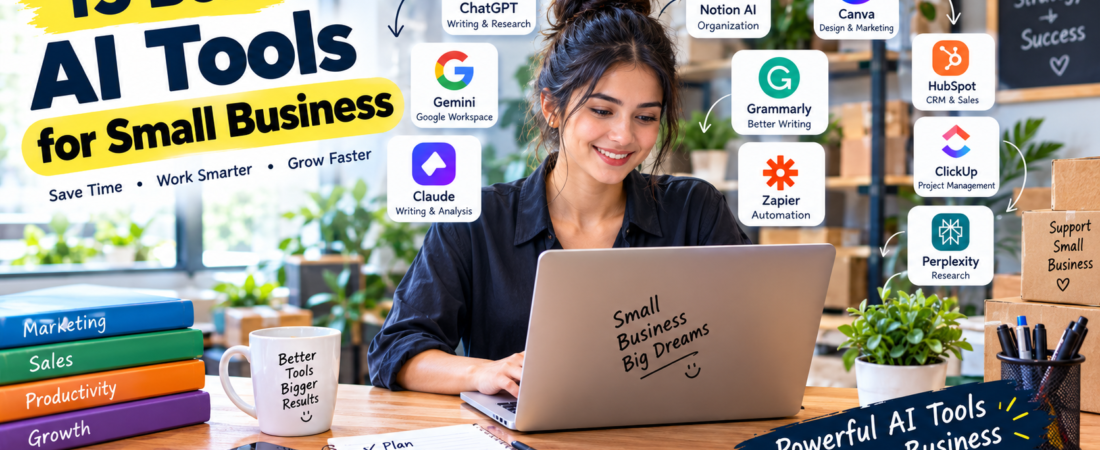
Best AI Tools for Small Business at a Glance
| Tool | Best For | Main Use |
|---|---|---|
| ChatGPT | General business tasks | Writing, research, ideas |
| Claude | Documents | Writing and analysis |
| Gemini | Google users | Research and Workspace |
| Microsoft Copilot | Microsoft users | Business productivity |
| Canva | Marketing | Graphics and content |
| Notion AI | Organization | Notes and knowledge |
| Grammarly | Business writing | Editing and rewriting |
| Perplexity | Research | Information discovery |
| Zapier | Automation | Connecting apps |
| HubSpot | CRM & marketing | Leads and customer management |
| ClickUp | Project management | Tasks and projects |
| Otter.ai | Meetings | Transcripts and summaries |
| Gamma | Presentations | AI presentations |
| Descript | Video content | Editing and transcription |
| Fireflies.ai | Meetings | Meeting notes |
1. ChatGPT
ChatGPT is a flexible AI assistant that can help with many everyday business tasks.
For example, a business owner can use it to draft emails, create content ideas, summarize documents, brainstorm marketing campaigns, write product descriptions, or prepare customer-service responses.
Moreover, it can be useful when you need a starting point quickly instead of creating everything from scratch.
Best for: General business productivity
Good for: Writing, research, brainstorming, planning
2. Claude
Claude is another useful AI assistant for businesses that work with documents and written information.
It can help organize ideas, summarize information, analyze documents, and improve written content. Therefore, it can be particularly useful for entrepreneurs who regularly handle proposals, reports, instructions, and other long-form material.
Best for: Documents and writing
Good for: Analysis, research, long-form content
3. Google Gemini
Google Gemini can be useful for businesses already working inside Google’s ecosystem.
It can assist with research, writing, brainstorming, and other everyday tasks. In addition, Google Workspace users may find AI features especially convenient because they can fit into existing work processes.
Best for: Google users
Good for: Research, writing, productivity
Google Gemini official website
4. Microsoft Copilot
Microsoft Copilot is designed for people who use Microsoft’s software ecosystem.
It can assist with writing, summarizing, brainstorming, and other productivity tasks. Consequently, businesses that already rely heavily on Microsoft products may find it easier to add AI without completely changing their workflow.
Best for: Microsoft users
Good for: Business productivity and documents
Microsoft Copilot official website
5. Canva
Canva can help small businesses create marketing materials without requiring advanced graphic-design skills.
You can use it for social media posts, presentations, advertisements, flyers, documents, and other visual content. In addition, Canva’s business tools include AI-powered features for creating and refining content. Canva
For a small team, this can make regular content creation much faster.
Best for: Marketing and design
Good for: Social media, presentations, graphics
6. Notion AI
Notion combines documents, notes, databases, and project organization.
With its AI features, users can work with information inside their workspace, summarize content, and create or improve written material. As a result, it can be useful for businesses that want to keep internal information organized in one place.
Best for: Business organization
Good for: Notes, documents, knowledge management
7. Grammarly
Professional communication matters for almost every business.
Grammarly can help improve grammar, clarity, tone, and wording in emails, documents, website copy, and other written communication. Furthermore, its AI features can assist with rewriting and adapting content for different purposes.
Best for: Business writing
Good for: Emails, documents, editing
8. Perplexity
Research can take a significant amount of time, especially when a business owner needs to understand a new market or topic.
Perplexity can help users explore questions and find information through an AI-powered search experience. Therefore, it can be useful during early-stage research, competitor research, and general information gathering.
Still, important business decisions should not rely on AI output alone. Always verify important facts with reliable sources.
Best for: Research
Good for: Information discovery and summaries
9. Zapier
Repetitive work is one of the biggest areas where automation can help a small business.
Zapier connects different applications and allows businesses to create automated workflows. For example, a new form submission could trigger actions in another application without requiring someone to manually copy the information.
Moreover, Zapier supports a large ecosystem of app integrations and AI-powered workflow features. Toolradar
Best for: Automation
Good for: Repetitive tasks and workflows
10. HubSpot
HubSpot is useful for businesses that need customer relationship management and marketing tools.
It can help businesses organize leads, manage customer interactions, and coordinate marketing activities. Additionally, HubSpot includes AI features across parts of its platform.
For a growing business, keeping customer information organized can become increasingly important.
Best for: CRM and marketing
Good for: Leads, customer management, marketing
11. ClickUp
ClickUp is a project-management platform that can help businesses organize tasks and projects.
AI features can assist with writing, summaries, and other project-related activities. Consequently, teams can use one workspace to manage tasks while reducing some manual administrative work.
Best for: Project management
Good for: Tasks, projects, team workflows
12. Otter.ai
Meetings can create a large amount of information that is difficult to remember later.
Otter.ai can transcribe conversations and create useful meeting summaries. Therefore, teams can spend less time manually writing notes and more time focusing on the discussion.
Best for: Meeting notes
Good for: Transcription and summaries
13. Gamma
Creating a professional presentation from a blank page can take considerable time.
Gamma helps users create presentations and other visual documents with AI. Instead of starting with an empty slide deck, you can generate an initial structure and then customize it for your business.
Best for: Presentations
Good for: Business presentations and visual documents
14. Descript
Descript is useful for businesses that create video or audio content.
Its transcription-based workflow can make editing spoken content easier. For example, businesses can use it when producing podcasts, tutorials, interviews, or marketing videos.
Best for: Video and audio content
Good for: Editing, transcription, podcasts
15. Fireflies.ai
Fireflies.ai focuses on meetings and meeting information.
It can help capture conversations, generate transcripts, and create summaries. As a result, teams can review important meeting information without manually writing everything down.
Best for: Meeting productivity
Good for: Transcripts, summaries, meeting records
How to Choose the Right AI Tool for Your Business
You do not need to purchase every AI tool available.
Instead, begin with the task that consumes the most time in your business. If writing takes too long, start with an AI writing assistant. If repetitive data movement is the problem, consider an automation platform. Meanwhile, businesses that struggle with meetings may benefit more from an AI meeting assistant.
For marketing
Canva, ChatGPT, and Grammarly can help with content and communication.
For research
Perplexity, ChatGPT, and Gemini are useful starting points.
For automation
Zapier can connect different apps and reduce repetitive work.
For customer management
HubSpot can help organize leads and customer information.
For project management
ClickUp and Notion can help organize tasks, documents, and projects.
Therefore, the best choice depends on your specific workflow rather than the number of features a product advertises.
How Small Businesses Can Use AI
AI can support many everyday business activities.
For example, a business owner could use ChatGPT to create an email draft, Canva to turn an idea into a social media graphic, and Grammarly to improve the final text.
After that, Zapier could automate a repetitive part of the workflow. Meanwhile, Notion or ClickUp could keep the resulting tasks organized.
This type of workflow is often more practical than trying to automate an entire business at once.
Recent small-business AI research also points toward using a small number of tools that solve specific workflow problems instead of purchasing a large collection of overlapping AI products. AI Dev
Are AI Tools Worth It for Small Businesses?
In many cases, yes.
However, the goal should not simply be to “use AI.” The real goal is to save time, reduce repetitive work, improve communication, or make existing processes easier.
Start small. Choose one problem, test one tool, and measure whether it actually improves your workflow.
If the tool saves meaningful time or improves the quality of your work, you can consider adding another solution later.
Frequently Asked Questions
What are the best AI tools for small business?
Some useful options include ChatGPT, Claude, Gemini, Canva, Notion AI, Grammarly, Perplexity, Zapier, HubSpot, and ClickUp. The right choice depends on the specific business task.
Can small businesses use AI for marketing?
Yes. AI can assist with content ideas, writing, social media posts, presentations, graphics, and marketing research. However, businesses should review AI-generated content before publishing it.
Are AI tools expensive for small businesses?
Not necessarily. Many tools provide free plans or trials. Nevertheless, advanced features may require paid subscriptions, so businesses should compare the cost with the actual time or value saved.
Can AI automate small business tasks?
Yes. Automation platforms such as Zapier can connect different applications and automate repetitive workflows. More advanced automation can also combine AI with business processes.
Should a small business use multiple AI tools?
It can, but there is no need to start with many tools. First identify the biggest bottleneck, then choose a tool that directly addresses it.
Conclusion
The best AI tools for small business are the ones that solve real problems.
ChatGPT and Claude can assist with general business work, while Canva can simplify visual content creation. Similarly, Notion and ClickUp can help organize projects, whereas Zapier can automate repetitive workflows.
Meanwhile, tools such as HubSpot, Otter.ai, Gamma, Descript, and Fireflies.ai can support specific areas of business operations.
Ultimately, start with one important task and test a suitable tool. Once you know that it saves time or improves your workflow, you can gradually build a simple AI-powered business stack.
For more practical AI guides, also read our articles on [AI productivity tools](/ai-productivity-tools/), [best AI image generators](/best-ai-image-generators/), [AI tools for content creators](/ai-tools-for-content-creators/), and [how to choose AI tools](/how-to-choose-ai-tools/).