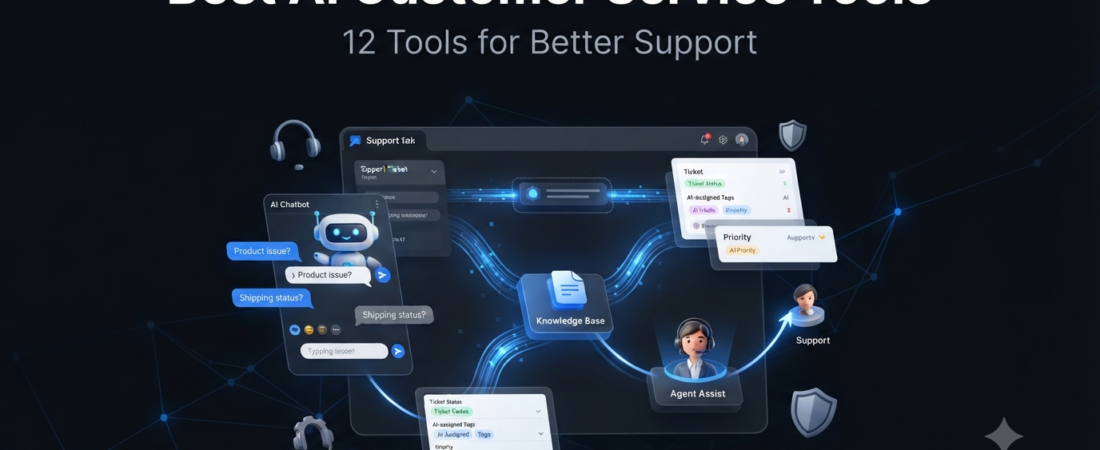
Why Use AI for Customer Service?
Customer support teams often receive the same questions repeatedly.
Customers may ask about shipping, pricing, refunds, products, accounts, or basic troubleshooting.
AI can handle many of these simple requests automatically.
Meanwhile, human agents can focus on complicated issues that require judgment or personal attention.
Faster Customer Responses
AI can respond to common questions almost immediately.
Therefore, customers do not always have to wait for a support representative.
Less Repetitive Work
Support agents can spend less time answering identical questions.
Instead, AI can handle common requests and allow employees to focus on more valuable work.
Support Outside Business Hours
AI assistants can continue answering supported questions when human agents are unavailable.
As a result, businesses can provide basic assistance beyond normal working hours.
Better Agent Productivity
AI can also help human support representatives.
For example, it can summarize conversations, suggest responses, and help agents find relevant information.
12 Best AI Customer Service Tools
Different businesses need different customer support systems.
Some tools are designed for small businesses, while others focus on enterprise teams.
Here are 12 options worth considering.
1. Intercom Fin
Intercom Fin is an AI customer service solution designed to automate customer conversations.
It can help answer questions using information from a company’s support content.
Additionally, businesses can combine AI assistance with human customer service.
Best for: SaaS companies and growing digital businesses.
2. Zendesk AI
Zendesk combines its established helpdesk platform with AI-powered customer service features.
Businesses can use AI for ticket management, response suggestions, summaries, and support automation.
Furthermore, Zendesk is suitable for organizations that need a more complete customer service platform.
Best for: Medium-sized and enterprise support teams.
3. Freshdesk Freddy AI
Freshdesk includes AI capabilities through its Freddy AI system.
It can assist with customer conversations, ticket classification, summaries, and support workflows.
Therefore, businesses can combine traditional helpdesk functionality with AI assistance.
Best for: Small and medium-sized businesses.
4. Tidio Lyro
Tidio combines live chat with AI-powered customer support.
Its AI assistant can answer common questions and automate parts of website support.
For ecommerce businesses, this can be particularly useful for product, shipping, and order-related questions.
Best for: Ecommerce stores and small online businesses.
5. HubSpot Customer Agent
HubSpot combines CRM, marketing, sales, and customer service tools.
Its AI customer service capabilities can work with information stored in the HubSpot ecosystem.
As a result, businesses already using HubSpot can keep customer information and support workflows connected.
Best for: Businesses using HubSpot CRM.
6. Ada
Ada focuses on AI-powered customer service automation.
It is designed for businesses that need to manage large volumes of customer conversations.
Moreover, it can support automated customer interactions across different channels.
Best for: Businesses with high support volumes.
7. Salesforce Agentforce
Salesforce Agentforce brings AI agents into the Salesforce ecosystem.
It can help businesses automate customer service and other CRM-related processes.
Because Salesforce contains customer information, AI workflows can work with relevant business context.
Best for: Salesforce-based businesses.
8. Help Scout
Help Scout is designed to make customer support easier for growing teams.
Its AI features can assist with writing responses and summarizing conversations.
Meanwhile, its support-focused interface keeps customer communication relatively straightforward.
Best for: Small support teams.
9. Kustomer
Kustomer focuses on customer service and CRM workflows.
Businesses can use it to manage customer conversations and organize support information.
Additionally, AI features can help with summaries and automated workflows.
Best for: Businesses managing high customer interaction volumes.
10. Chatbase
Chatbase allows businesses to create AI assistants for websites and other customer-facing experiences.
Businesses can connect their information and create assistants that answer questions using that knowledge.
Therefore, it can be useful for companies that want a customized AI support assistant.
Best for: Websites and knowledge-base support.
11. Crisp
Crisp combines customer messaging, shared inbox features, automation, and AI.
It can help small teams manage customer conversations from a central platform.
Furthermore, businesses can keep human agents involved when automated assistance is not enough.
Best for: Startups and small online businesses.
12. WATI
WATI focuses heavily on WhatsApp-based business communication.
Businesses can use it for customer conversations, notifications, marketing workflows, and support automation.
For businesses that rely heavily on WhatsApp, this can be particularly useful.
Best for: WhatsApp customer support.
AI Customer Service Tools vs Traditional Chatbots
Traditional chatbots usually depend on predefined rules.
For example, a simple chatbot might recognize a keyword and display a predetermined answer.
Modern AI systems can understand different ways of asking the same question.
They can also summarize conversations, retrieve information, and assist with more complex workflows.
However, AI does not eliminate the need for human support.
Complex complaints or sensitive situations may still require a human representative.
Therefore, businesses should combine AI automation with clear human handoff processes.
Benefits of AI Customer Service Software
1. Faster Support
AI can answer supported questions quickly.
This can reduce the waiting time for customers.
2. Reduced Workload
AI can handle repetitive questions that would otherwise require manual responses.
As a result, support teams can spend more time on complex requests.
3. Better Scalability
Businesses can manage increasing support volumes without increasing manual work at the same rate.
4. Consistent Information
An AI assistant connected to an accurate knowledge base can provide consistent answers.
However, businesses should regularly review the information used by the system.
5. Better Agent Assistance
AI can help support employees summarize conversations and prepare responses.
This can make customer service workflows more efficient.
How to Choose the Best AI Customer Service Tool
Choosing the right platform depends on your business requirements.
Consider Your Main Support Channel
First, identify where your customers usually contact you.
This could be:
- Website chat
- Social media
- Phone
- Helpdesk tickets
Then choose a tool that works well with your most important channels.
Check Software Integrations
Your support platform should ideally connect with your existing software.
For example, you may need integrations with your CRM, ecommerce platform, email system, or order management software.
Without useful integrations, an AI assistant may have limited business context.
Look for Human Handoff
A good AI support system should allow customers to reach a human when necessary.
Therefore, check how easily conversations can be transferred to support agents.
Compare Pricing
AI customer service platforms use different pricing models.
Some charge by agent or seat, while others may charge according to conversations, AI resolutions, or usage.
Consequently, compare the pricing based on your expected support volume rather than only looking at the starting price.
Test the AI Before Launching
Always test the system with realistic customer questions.
Check whether it provides accurate answers and understands different ways of asking the same question.
Also, test what happens when the AI does not know the answer.
AI Customer Service for Small Businesses
Small businesses do not always need an expensive enterprise platform.
A smaller AI chatbot or helpdesk can handle many common questions.
For example, an online store could automate answers about:
- Product details
- Shipping times
- Order tracking
- Return policies
- Payment methods
- Store policies
Meanwhile, complicated issues can be transferred to a human.
You can also explore our guide to AI tools for small business for more business-focused software.
If you want to automate the processes behind your support system, check our guide to AI automation tools.
How to Get Better Results From AI Support
Simply installing an AI chatbot is not enough.
Businesses should give the system accurate information about products, policies, pricing, and support procedures.
Furthermore, review conversations regularly to identify incorrect answers.
When customers repeatedly ask questions that the AI cannot answer, add better information to the knowledge base.
Over time, this can improve the usefulness of the support system.
Are AI Customer Service Tools Worth It?
AI customer service tools can be valuable when a business receives many repetitive questions.
However, the technology should solve a real business problem.
For example, a small website receiving only a few customer messages each week may not need an advanced enterprise platform.
On the other hand, an ecommerce store receiving hundreds of repetitive questions may benefit significantly from automation.
Therefore, evaluate your support volume before choosing a platform.
Frequently Asked Questions
What are AI customer service tools?
AI customer service tools use artificial intelligence to help businesses answer customer questions, automate support tasks, manage conversations, and assist human agents.
What is the best AI customer service tool?
There is no single best option for every business. Intercom, Zendesk, Freshdesk, Tidio, HubSpot, and other platforms serve different requirements.
Can AI handle customer support?
Yes. AI can handle many repetitive questions and support tasks. However, complicated or sensitive issues should have a clear path to human assistance.
Are AI customer service tools good for ecommerce?
Yes. Ecommerce businesses can use AI to answer questions about products, orders, shipping, returns, and store policies.
Can small businesses use AI customer support?
Yes. Many platforms provide solutions suitable for small businesses. The right choice depends on support volume, budget, channels, and required integrations.
What is the difference between an AI chatbot and an AI agent?
An AI chatbot may mainly answer questions, while an AI agent can potentially understand a request, use connected systems, make decisions, and perform actions within a workflow.
Conclusion
AI customer service tools can help businesses respond faster while reducing repetitive support work.
Modern platforms go beyond simple chatbots.
They can assist with customer conversations, ticket management, knowledge retrieval, workflow automation, and human-agent productivity.
For small businesses, tools such as Tidio, Crisp, Chatbase, and Freshdesk can be practical starting points.
Meanwhile, larger organizations may prefer platforms such as Zendesk, Intercom, Salesforce, or Ada.
Most importantly, choose a platform based on your actual customer-service needs.
Start with one repetitive support problem, provide accurate information, test the AI carefully, and maintain a reliable human handoff.
Related Aiventa Guide Articles
- AI Agents for Business
- AI Automation Tools
- AI Tools for Small Business
- AI Productivity Tools
- AI Presentation Tools
- How to Choose AI Tools
Affiliate Disclosure: Some links to AI tools may become affiliate links in the future. If Aiventa Guide earns a commission from an eligible purchase, it will be at no additional cost to the reader. Recommendations are based on usefulness and relevance.