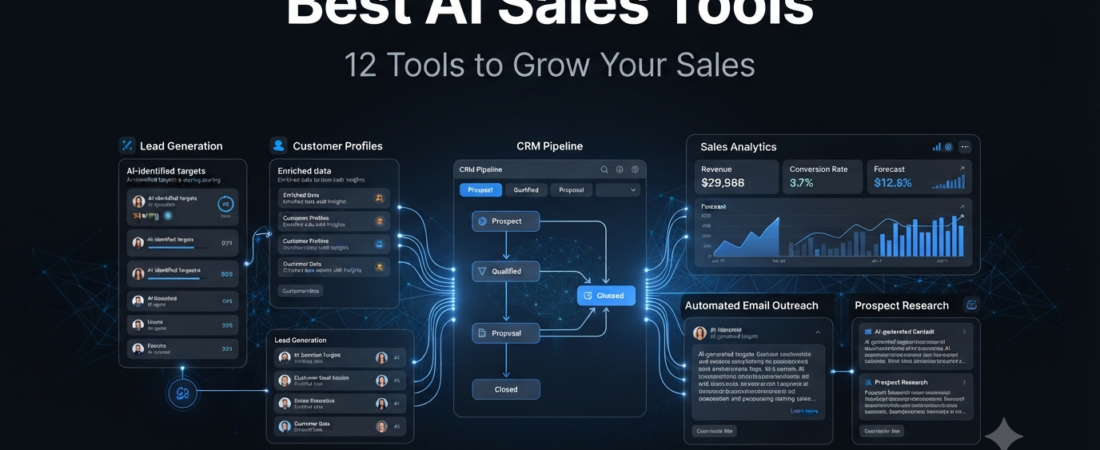
Best AI Sales Tools: 12 Tools to Grow Your Sales
Sales teams spend a lot of time finding prospects, researching companies, writing emails, updating CRM records, and following up with leads.
AI sales tools can help automate many of these repetitive activities.
Modern AI sales software can assist with prospect research, lead prioritization, personalized outreach, meeting preparation, CRM management, and sales automation.
As a result, sales professionals can spend more time building relationships and closing deals.
In this guide, we will look at some of the best AI sales tools and explain what each one is useful for.
If you are also interested in broader business automation, check our guide to AI automation tools.
What Are AI Sales Tools?
AI sales tools are software applications that use artificial intelligence to assist with different parts of the sales process.
Depending on the platform, they can help businesses find prospects, analyze customer information, write outreach messages, automate follow-ups, or manage CRM data.
For example, an AI sales platform may identify potential prospects and prioritize them based on available buying signals.
Another tool might analyze a sales conversation and create a summary for the sales representative.
Therefore, AI sales tools can be useful at multiple stages of the sales funnel.
Why Use AI for Sales?
Sales involves many repetitive tasks.
A salesperson may spend hours researching prospects before sending a single message.
Similarly, manually updating CRM records after meetings can take significant time.
AI can reduce some of this administrative workload.
Save Time
AI can automate repetitive sales activities.
For example, it can help summarize meetings, prepare emails, organize information, and prioritize tasks.
Find Better Prospects
Some AI tools analyze company information and buying signals to help sales teams identify potentially valuable prospects.
Personalize Outreach
AI can help salespeople create personalized messages based on a prospect’s company, role, industry, or other available information.
Improve Follow-Ups
AI-powered workflows can remind salespeople about follow-ups or automate appropriate parts of the outreach process.
Keep CRM Data Organized
AI can assist with data entry, summaries, activity tracking, and other CRM tasks.
HubSpot, for example, currently offers AI-powered sales features for prospect research, prioritization, meeting preparation, and sales workflows.
12 Best AI Sales Tools
The best AI sales tool depends on your sales process, team size, budget, and goals.
Here are 12 tools worth exploring.
| Tool | Best For | Main Use |
|---|---|---|
| HubSpot Sales Hub | Sales CRM | CRM + AI sales |
| Salesforce | Enterprise sales | CRM + AI |
| Apollo | Prospecting | Lead data + outreach |
| Clay | Lead research | Data enrichment |
| Zoho CRM | Small businesses | AI CRM |
| Freshsales | Growing teams | CRM + AI |
| Gong | Sales conversations | Conversation intelligence |
| Lavender | Sales emails | Email optimization |
| Pipedrive | Sales pipelines | CRM automation |
| 6sense | B2B sales | Intent data |
| Avoma | Meetings | Meeting intelligence |
| ChatGPT | Sales assistance | Research + content |
1. HubSpot Sales Hub
HubSpot Sales Hub combines CRM functionality with AI-powered sales features.
It can help sales teams manage leads, track deals, prepare for meetings, and prioritize sales activities.
Its AI-powered prospecting capabilities can also help research prospects and create personalized outreach workflows.
Best for: Businesses wanting CRM and AI sales features in one platform.
2. Salesforce
Salesforce is a major CRM platform with AI capabilities built into its sales ecosystem.
Businesses can use AI to assist with lead qualification, sales insights, forecasting, customer information, and repetitive sales activities.
Furthermore, Salesforce is designed for organizations with more complex sales operations.
Best for: Medium-sized and enterprise businesses.
3. Apollo
Apollo combines prospecting, contact data, enrichment, and outbound sales functionality.
Businesses can use it to find potential customers and organize prospects for outreach.
Apollo also supports integrations with CRM platforms such as HubSpot, allowing sales data to move between systems.
Best for: B2B prospecting and outbound sales.
4. Clay
Clay focuses on lead research and data enrichment.
It can combine information from multiple data sources and use AI to help research prospects.
Therefore, it can be useful for sales teams that need detailed information before contacting potential customers.
Best for: Lead research and data enrichment.
5. Zoho CRM
Zoho CRM provides CRM functionality along with AI features through its Zia assistant.
Businesses can use it to manage leads, customer information, sales pipelines, and other CRM activities.
For smaller businesses, it can be an attractive option when they want CRM and AI capabilities without moving to a large enterprise platform.
Best for: Small and growing businesses.
6. Freshsales
Freshsales combines CRM functionality with AI-powered sales assistance.
It can help sales teams organize leads, track deals, and manage customer information.
Additionally, its AI features can assist with sales insights and prioritization.
Best for: Growing sales teams.
7. Gong
Gong focuses on sales conversation intelligence.
It can analyze sales calls and conversations to provide useful insights for sales teams.
For example, managers can use conversation data to understand common objections, sales patterns, and opportunities for improvement.
Best for: Sales teams focused on call analysis and coaching.
8. Lavender
Lavender is designed to help salespeople improve their email communication.
It can analyze sales emails and provide suggestions for making messages clearer and more effective.
As a result, it can be useful when email outreach is an important part of your sales process.
Best for: Sales email writing and optimization.
9. Pipedrive
Pipedrive is a sales CRM focused on managing pipelines and deals.
Its automation and AI-related capabilities can help sales teams organize activities and keep track of opportunities.
Therefore, it can be a practical choice for teams that want a straightforward sales pipeline.
Best for: Sales pipeline management.
10. 6sense
6sense focuses on B2B revenue intelligence and buyer intent.
It helps sales and marketing teams identify accounts that may be showing signals of purchase interest.
This can help teams prioritize accounts instead of treating every lead equally.
Best for: B2B account targeting and intent data.
11. Avoma
Avoma focuses on meeting intelligence and conversation workflows.
It can help record, transcribe, summarize, and analyze sales meetings.
Consequently, sales representatives can spend less time manually writing meeting notes.
Best for: Sales meetings and conversation intelligence.
12. ChatGPT
ChatGPT can act as a flexible AI sales assistant for many everyday tasks.
Sales professionals can use it for prospect research, email drafts, proposal ideas, meeting preparation, customer research, and brainstorming.
However, sensitive customer information should only be used in accordance with your organization’s privacy and data policies.
Best for: General sales assistance and content tasks.
AI Sales Tools vs Traditional Sales Software
Traditional sales software mainly stores and organizes information.
For example, a CRM can keep customer records, deals, contacts, and sales activities in one place.
AI adds another layer.
Instead of only storing information, AI can analyze it and provide suggestions or automate certain tasks.
For example:
Traditional CRM: Stores customer information.
AI-powered CRM: Can analyze customer information and suggest next actions.
Therefore, AI sales software can help teams move from simply managing data to using that data more effectively.
How AI Sales Automation Works
AI sales automation usually combines several steps.
Step 1: Find Prospects
The system identifies potential customers based on specific criteria.
Step 2: Research Leads
AI can gather or summarize information about companies and prospects.
Step 3: Prioritize Leads
Some platforms use available signals to help determine which prospects may deserve attention first.
Step 4: Prepare Outreach
AI can help create personalized emails or other sales messages.
Step 5: Follow Up
Automation can remind sales representatives about follow-ups or manage appropriate automated sequences.
Step 6: Update the CRM
Information from sales activities can be recorded in the CRM.
This creates a connected workflow instead of forcing salespeople to manually manage every step.
How to Choose the Best AI Sales Tool
Choosing the right tool starts with identifying your biggest sales problem.
For Lead Generation
Look at tools focused on prospecting, databases, and lead research.
Apollo and Clay are examples of platforms that can help with this area.
For CRM
If your biggest problem is managing leads and deals, consider an AI-powered CRM.
HubSpot, Salesforce, Zoho CRM, and Freshsales are examples.
For Sales Emails
If your team sends many cold or follow-up emails, an email-focused AI tool may be more useful.
Lavender is one example.
For Sales Calls
Teams that want to analyze conversations can look at platforms such as Gong or Avoma.
For Complete Sales Workflows
If you need multiple sales activities connected together, consider a platform that combines CRM, automation, prospecting, and AI.
AI Sales Tools for Small Businesses
Small businesses do not necessarily need a complicated sales technology stack.
In many cases, one CRM combined with one or two specialized AI tools can be enough.
For example, a small B2B company could use a CRM to manage leads and an AI prospecting tool to research potential customers.
Meanwhile, AI can help create follow-up emails and summarize sales meetings.
This approach can keep the workflow simple while still reducing repetitive work.
For more business software recommendations, check our guide to AI tools for small business.
You can also explore AI agents for business to understand how AI agents can perform more complex business tasks.
Common Mistakes to Avoid
AI can improve sales workflows, but it should not be used without a strategy.
Automating Everything
Not every sales activity should be automated.
Relationship-building and important customer conversations often require a human touch.
Sending Generic AI Messages
AI-generated outreach can become ineffective when every prospect receives the same message.
Instead, use AI to support personalization rather than replacing thoughtful communication.
Ignoring Data Quality
Poor CRM data can lead to poor AI recommendations.
Therefore, keep customer and prospect information accurate.
Using Too Many Tools
Adding several overlapping AI tools can make your sales process more complicated.
Start with the biggest problem and add tools only when they provide clear value.
Are AI Sales Tools Worth It?
AI sales tools can be valuable when they reduce repetitive work or help salespeople make better decisions.
However, the best tool is not necessarily the one with the most AI features.
Instead, look for software that fits your existing workflow.
A simple CRM with useful automation can be more valuable than a complicated platform that your team rarely uses.
Therefore, start with one clear sales problem and measure whether the tool actually improves your workflow.
Frequently Asked Questions
What are AI sales tools?
AI sales tools are software applications that use artificial intelligence to assist with prospecting, lead generation, outreach, CRM management, sales analysis, and other sales activities.
What is the best AI sales tool?
There is no single best option for every business. HubSpot, Salesforce, Apollo, Clay, Zoho CRM, and other platforms serve different sales requirements.
Can AI generate sales leads?
Yes. Some AI sales platforms can help identify, research, enrich, and prioritize potential leads.
Can AI write sales emails?
Yes. AI can help create and improve sales emails. However, messages should be reviewed and personalized before being sent.
Are AI sales tools useful for small businesses?
Yes. Small businesses can use AI for prospect research, CRM management, email writing, follow-ups, and sales automation.
Can AI replace salespeople?
AI can automate certain repetitive sales activities, but it does not completely replace the relationship-building, judgment, and communication skills required in many sales situations.
Conclusion
AI sales tools are becoming useful across almost every stage of the modern sales process.
They can help businesses find prospects, research leads, write outreach, analyze conversations, manage CRM data, and automate repetitive activities.
For prospecting, tools such as Apollo and Clay can be useful.
For CRM and sales management, HubSpot, Salesforce, Zoho CRM, and Freshsales offer broader solutions.
Meanwhile, platforms such as Gong, Lavender, and Avoma focus on specific sales activities.
The best approach is to start with one clear problem.
Choose a tool that fits your workflow, test the results, and expand your AI sales stack only when it creates measurable value.
Related Aiventa Guide Articles
- AI Customer Service Tools
- AI Agents for Business
- AI Automation Tools
- AI Tools for Small Business
- AI Productivity Tools
- AI Presentation Tools
- How to Choose AI Tools
Affiliate Disclosure: Some links to AI tools may become affiliate links in the future. If Aiventa Guide earns a commission from an eligible purchase, it will be at no additional cost to the reader. Recommendations are based on usefulness and relevance.