What Are AI Voice Agents?
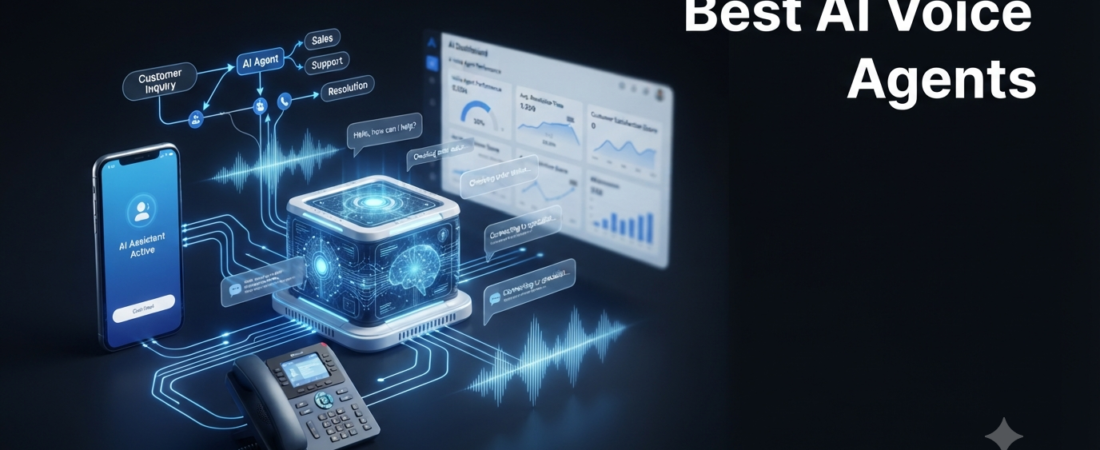
AI voice agents are AI-powered systems that can have spoken conversations with people in real time. Instead of typing messages into a chatbot, customers can simply talk to the AI over a phone call or another voice interface.
These systems generally combine speech recognition, a language model, voice generation, and phone or communication technology. As a result, they can listen to a caller, understand the request, respond naturally, and sometimes take an action.
For example, an AI voice agent can answer a business call, collect customer information, schedule an appointment, qualify a sales lead, or transfer the conversation to a human.
The technology has moved beyond simple automated phone menus. Current platforms focus heavily on natural conversation, faster responses, integrations, and workflow automation.
If you are interested in the broader technology behind these systems, you can also read our guide to what is agentic AI.
Best AI Voice Agents
Here are seven AI voice platforms worth considering for different types of users and businesses.
1. Retell AI — Best for Production Voice Agents
Retell AI is designed for teams that want to build and deploy real-time AI phone agents.
The platform focuses on conversational quality, call handling, integrations, and production workflows. It can be useful for businesses that need an AI receptionist, appointment assistant, lead qualification system, or customer support agent.
Best for: Businesses and teams building production phone agents.
Key strengths:
- Real-time voice conversations
- Phone-call automation
- Workflow integrations
- Support for inbound and outbound use cases
- Developer-friendly controls
Retell is frequently compared with platforms such as Vapi, Bland, Synthflow, and ElevenLabs because each targets a slightly different part of the voice AI market.
2. Vapi — Best for Developers
Vapi is a strong option for developers who want more control over how their voice agents work.
Instead of giving you only a finished AI receptionist, Vapi provides infrastructure that developers can use to create custom voice applications.
That flexibility makes it suitable for startups, software products, agencies, and teams that want to connect voice conversations with their own APIs, databases, or business workflows.
Best for: Developers and technical teams.
Key strengths:
- API-based development
- Custom voice workflows
- Flexible integrations
- Developer control
- Support for custom AI stacks
Vapi is generally positioned as developer infrastructure rather than a simple plug-and-play business application.
3. ElevenLabs — Best for Natural AI Voices
ElevenLabs is well known for its AI voice technology and has expanded into conversational AI and voice agents.
For businesses where voice quality and natural-sounding speech matter, ElevenLabs can be particularly interesting.
The company is also expanding aggressively in India. In October 2026, Reuters reported that ElevenLabs planned to invest hundreds of millions of dollars in India while expanding local teams and Indian-language capabilities.
Best for: Businesses that prioritize voice quality and multilingual experiences.
Key strengths:
- Natural AI voices
- Multilingual capabilities
- Voice generation technology
- Conversational AI
- Strong developer ecosystem
4. Bland AI — Best for Phone Automation
Bland AI focuses heavily on automated phone conversations.
Businesses can use this type of platform for tasks such as outbound calls, lead qualification, customer communication, and other repetitive phone workflows.
The biggest advantage is that voice automation can handle repetitive conversations without requiring a human employee to answer every call.
Best for: High-volume phone workflows and outbound calling.
Key strengths:
- Automated phone calls
- Outbound workflows
- Lead qualification
- Call automation
- Business integrations
However, businesses should carefully design call rules and escalation processes before allowing an AI agent to handle important customer conversations.
5. Synthflow — Best No-Code AI Voice Agent
Synthflow is designed for users who want to create AI voice agents without building everything from scratch.
Its no-code approach can make it attractive to agencies, small businesses, and non-technical teams.
For example, a business could create an AI receptionist that answers common questions and routes important calls to a human.
Best for: Non-technical users and agencies.
Key strengths:
- No-code workflow building
- AI phone assistants
- Business integrations
- Appointment workflows
- Customer support automation
If you are already exploring business automation, our guide to AI automation tools can help you understand where voice agents fit into a larger automation system.
6. PolyAI — Best for Enterprise Customer Conversations
PolyAI focuses on conversational AI for customer service and enterprise environments.
Instead of simply answering predefined questions, conversational voice systems aim to understand what customers actually want and guide the conversation accordingly.
That can be useful for organizations handling large numbers of customer calls.
Best for: Enterprise customer service.
Key strengths:
- Conversational customer service
- Voice automation
- Enterprise workflows
- Call handling
- Customer experience automation
For smaller businesses, however, a simpler platform may be easier to deploy and manage.
7. OpenAI Realtime API — Best for Custom Voice Experiences
For developers building their own applications, real-time AI APIs can provide another approach.
Instead of purchasing a complete AI receptionist product, developers can integrate real-time voice capabilities into their own software.
This approach gives a technical team more control over the final experience. At the same time, it requires more development work than a no-code platform.
Best for: Developers building custom AI voice applications.
Best AI Voice Agents Compared
| AI Voice Agent | Best For | Main Strength |
|---|---|---|
| Retell AI | Production teams | Real-time voice workflows |
| Vapi | Developers | Flexibility and API control |
| ElevenLabs | Voice-focused businesses | Natural voices |
| Bland AI | Phone automation | Outbound workflows |
| Synthflow | Non-technical teams | No-code building |
| PolyAI | Enterprise | Customer conversations |
| OpenAI Realtime API | Developers | Custom voice experiences |
The platforms are not identical. Some are developer infrastructure, while others are designed to help businesses launch an AI phone agent quickly.
What Can AI Voice Agents Do?
AI voice agents can handle many repetitive conversations.
Common examples include:
- Answering frequently asked questions
- Booking appointments
- Confirming appointments
- Qualifying sales leads
- Collecting customer information
- Routing calls
- Providing basic customer support
- Following up with leads
- Handling repetitive inbound calls
- Triggering actions in connected business systems
For example, a dental clinic could use an AI receptionist to answer basic questions and help customers request an appointment.
Similarly, a real-estate business could use an AI agent to qualify an incoming lead before sending the information to a salesperson.
AI Voice Agents for Small Businesses
Small businesses can benefit from voice AI when employees spend too much time answering repetitive calls.
A local service business, for instance, may receive calls asking about opening hours, pricing, availability, or appointment times.
Instead of making employees answer every basic question, an AI voice agent can handle suitable conversations and send complicated requests to a human.
This makes voice AI especially interesting alongside other business automation tools.
You can also explore our guides on AI tools for small business and AI agents for business.
AI Voice Agents for Customer Support
Customer service is another major use case.
A voice agent can handle simple questions before escalating more complicated problems to a human representative.
However, businesses should not assume that an AI agent can replace every customer-service conversation.
Sensitive issues, complaints, unusual requests, and situations requiring human judgment should have a clear human handoff.
That approach creates a better balance between automation and customer experience.
For more customer-service automation ideas, see our guide to AI customer service tools.
AI Voice Agents for Sales
Sales teams can also use voice AI for repetitive parts of the sales process.
An AI agent could potentially collect basic information from an inbound lead, ask qualifying questions, and send the conversation data to a CRM.
Afterward, a human salesperson can take over when the lead is ready for a more detailed conversation.
This approach can reduce repetitive work while keeping humans involved in important sales decisions.
Our guide to AI sales tools covers other AI applications that can support sales teams.
Are AI Voice Agents Reliable?
AI voice agents have improved significantly, but they are not perfect.
A voice agent can misunderstand a caller, provide an incorrect answer, or fail to understand an unusual request. Therefore, businesses should start with clearly defined tasks instead of giving an AI unrestricted control.
In addition, privacy and security matter because voice agents may interact with customer information and business systems.
Organizations should review data handling, permissions, call recording practices, human escalation, and compliance requirements before deployment.
Security is becoming particularly important as AI agents gain access to more business systems and can perform actions rather than simply provide information.
How to Choose the Best AI Voice Agent
Start by identifying the problem you want to solve.
If you are a developer, Vapi or a customizable platform may be more suitable.
For a no-code setup, Synthflow can be easier to explore.
If voice quality is the main priority, ElevenLabs deserves attention.
For production phone workflows, Retell AI is another strong option.
Meanwhile, businesses focused heavily on outbound phone automation may prefer Bland AI.
In other words, there is no single best AI voice agent for everyone. The right choice depends on your workflow, technical skills, call volume, integrations, language requirements, and budget.
Tips for Getting Better Results From AI Voice Agents
Before launching a voice agent, keep the first workflow simple.
Start with a small number of tasks and clearly define what the AI should and should not do.
Next, create a reliable human handoff. Customers should be able to reach a person when the AI cannot solve the problem.
Also, test real conversations instead of relying only on demonstrations.
Finally, review calls regularly and improve the agent based on real customer interactions.
This approach is much safer than trying to automate an entire customer-service operation on day one.
Frequently Asked Questions
What is the best AI voice agent?
There is no universal winner. Retell AI, Vapi, ElevenLabs, Bland AI, and Synthflow each target different use cases.
Can AI voice agents answer phone calls?
Yes. Many AI voice platforms are designed specifically to handle real-time phone conversations.
Can AI voice agents book appointments?
Yes. With the appropriate integrations and workflow setup, an AI voice agent can help automate appointment scheduling.
Are AI voice agents good for small businesses?
They can be useful for repetitive calls, appointment requests, lead qualification, and basic customer support.
Can AI voice agents replace customer service employees?
They can automate some repetitive tasks, but human support remains important for complex, sensitive, or unusual situations.
Are AI voice agents expensive?
Costs vary considerably because some platforms charge for platform usage while other costs can come from AI models, voice generation, and telephony. Always check the provider’s current pricing before choosing a platform.
Final Thoughts
AI voice agents are becoming an important part of the broader AI agent ecosystem.
Instead of only answering questions through text, these systems can communicate through spoken conversations and connect those conversations with business workflows.
For developers, Vapi offers flexibility. Retell AI focuses on production voice workflows, while ElevenLabs is particularly interesting for natural voice experiences. Synthflow can appeal to non-technical users, and other platforms specialize in enterprise or outbound use cases.
The best strategy is to start small.
Choose one repetitive phone task, test the AI with real conversations, measure the results, and add more automation only when the first workflow works reliably.
As AI agents become more capable, voice could become one of the most practical ways for customers to interact with automated business systems.
Affiliate Disclosure
Some links on Aiventa Guide may be affiliate links. If you purchase a product through an affiliate link, we may earn a commission at no additional cost to you. We only aim to recommend tools that are relevant to the topic and useful to our readers.