Artificial intelligence is moving beyond simple question-and-answer chatbots. The next major step is agentic AI, where AI systems can understand a goal, plan multiple steps, use tools, and complete tasks with less human intervention.
Instead of only generating an answer, an AI agent can potentially research information, make decisions, interact with software, and continue working toward a specific objective.
This shift is attracting significant attention from businesses and technology companies. Google is adding agentic capabilities to Search, while companies are increasingly experimenting with agents for coding, customer service, operations, and other workflows.
But what exactly is agentic AI, and how is it different from ordinary generative AI?
What Is Agentic AI?
Agentic AI is a type of artificial intelligence designed to pursue a goal by reasoning through multiple steps and taking actions, rather than simply responding to a single prompt.
A traditional chatbot generally follows a simple pattern:
User → Prompt → AI Response
An agentic AI system can follow a more advanced process:
Goal → Plan → Use Tools → Take Actions → Check Results → Continue
For example, imagine asking an AI:
“Research three software options for my business and prepare a comparison.”
A basic AI may provide a comparison based on information it already knows.
An AI agent, depending on its available tools and permissions, could potentially search websites, collect information, compare the options, organize the findings, and produce a final report.
That ability to work through a multi-step objective is what makes agentic AI different.
How Do AI Agents Work?
Although implementations vary, most AI agents involve several important components.
1. Goal or instruction
Everything starts with an objective.
For example, a user might ask an agent to:
- Research competitors
- Organize information
- Write a report
- Analyze a dataset
- Assist with coding
- Handle a repetitive workflow
The agent first needs to understand what outcome is expected.
2. Planning
Instead of immediately producing an answer, an agent can break a larger task into smaller steps.
For example, a research task might involve:
- Identify relevant sources.
- Gather information.
- Compare the information.
- Check for missing details.
- Organize the findings.
- Produce the final result.
The exact planning process depends on the AI system and its design.
3. Tool usage
Tools are one of the most important parts of agentic AI.
An agent may be connected to tools such as:
- Web search
- Databases
- APIs
- Code execution
- Business software
- File systems
- Communication platforms
This allows the AI to do more than generate text.
For example, coding agents can interact with development environments, while business agents may connect to company systems.
4. Taking actions
Once the agent determines what needs to happen, it can perform an action through an available tool.
Depending on the system, this might mean creating a document, updating information, running code, retrieving data, or starting another step in a workflow.
However, the level of autonomy varies. Some agents require human approval before important actions, while others can operate with more independence.
5. Checking the result
A useful agentic system can evaluate whether an action produced the expected result.
If something went wrong, it may adjust its approach and try another step.
This creates a feedback loop rather than a single prompt-and-response interaction.
Agentic AI vs Generative AI
Agentic AI and generative AI are related, but they are not exactly the same thing.
| Feature | Generative AI | Agentic AI |
|---|---|---|
| Main purpose | Generate content or answers | Complete goals and tasks |
| Typical interaction | Prompt and response | Goal and multi-step execution |
| Planning | Usually limited | Often central |
| Tool use | May be available | Usually important |
| Autonomy | Generally lower | Can be higher |
| Multi-step workflows | Limited or user-driven | Core capability |
| Example | Writing an article | Researching, organizing and completing a workflow |
Generative AI can therefore be considered an important building block for many AI agents.
In practice, however, agentic systems can combine AI models with tools, memory, workflows, APIs, and other software components.
What Can Agentic AI Do?
The potential applications of AI agents are expanding quickly.
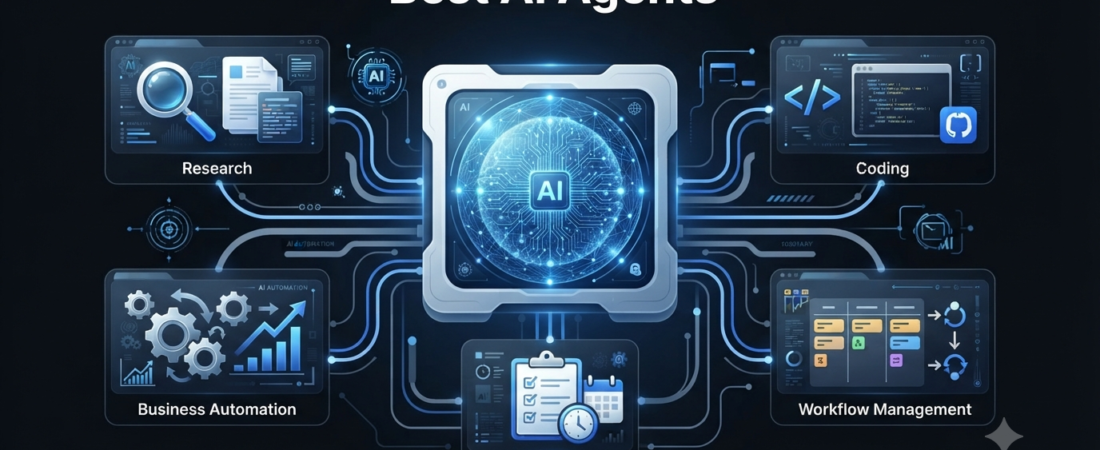
AI agents for business
Businesses can use agents to automate repetitive processes, assist employees, and connect different software systems.
Common examples include:
- Customer support
- Lead qualification
- Research
- Sales assistance
- Data processing
- Document handling
- Internal knowledge search
If you’re interested specifically in business applications, see our guide to AI agents for business.
AI coding agents
Software development is another major area for agentic AI.
Coding agents can help developers understand codebases, write code, identify problems, test changes, and work through larger development tasks.
Research from McKinsey indicates that organizations are already scaling agentic coding tools, making this one of the most practical areas of agent adoption.
You can also explore our guide to AI tools for coding to learn more.
AI workflow automation
Agentic AI can also be combined with automation platforms to create multi-step workflows.
For example, a workflow could potentially:
Receive information → Analyze it → Make a decision → Update software → Notify a person
This is different from simple automation because an AI component can interpret information and determine the next step.
For more examples, check our guide to AI automation tools.
AI research
Research is another promising application.
An agent can potentially search multiple sources, organize information, compare findings, and create a structured report.
This is particularly useful for tasks that require several research steps rather than a single factual answer.
Why Is Agentic AI Growing So Quickly?
There are several reasons behind the growing interest.
First, AI models are becoming better at reasoning and handling complex instructions.
Second, AI systems can now connect to more external tools and software.
Third, businesses are looking beyond AI-generated content toward automation and measurable productivity improvements.
Current research supports this shift. Anthropic’s 2026 research found strong optimism around AI agents, while also identifying integration and data quality as major barriers to adoption.
Google is also building agentic capabilities directly into Search, including systems designed to perform ongoing information tasks.
Therefore, agentic AI is increasingly becoming a practical software category rather than only a research concept.
What Are the Benefits of Agentic AI?
When implemented correctly, agentic AI can offer several advantages.
Saves time
Agents can handle repetitive multi-step tasks that would otherwise require manual work.
Works across multiple tools
Instead of keeping information inside one AI chat, an agent can potentially interact with several connected systems.
Handles complex workflows
Agents can break larger objectives into smaller tasks and work through them sequentially.
Supports employees
Rather than replacing every human decision, agents can assist employees by handling routine work and leaving people to focus on higher-value tasks.
Scales repetitive processes
A well-designed workflow can potentially process many similar tasks without requiring someone to manually perform every step.
What Are the Limitations of Agentic AI?
Agentic AI is powerful, but it is not perfect.
Incorrect decisions
AI agents can misunderstand instructions or make incorrect decisions. Human review is still important for sensitive workflows.
Data and integration problems
Agents need reliable access to the right information. Poor data quality or disconnected software can reduce their usefulness. Anthropic’s 2026 research identifies integration and data access/quality among the leading challenges for organizations adopting agents.
Security risks
Giving an AI system access to tools creates additional security considerations.
An agent that can access business systems needs carefully designed permissions, monitoring, and safeguards.
Cost
Complex agentic systems may require multiple model calls, external tools, APIs, or infrastructure, which can increase operating costs.
Human oversight
For important actions, organizations may still want humans to approve decisions before an agent executes them.
Are AI Agents the Future of AI?
AI agents are likely to become an increasingly important part of software, although the technology is still developing.
Gartner’s 2026 analysis describes agentic AI as receiving significant market attention while noting that many organizations are still experimenting with relatively narrow applications.
The most realistic future may not be completely autonomous AI replacing every workflow.
Instead, we may see humans and AI agents working together.
For example, a person could define the goal, an agent could handle routine steps, and the human could review important decisions.
That approach combines automation with human judgment.
Frequently Asked Questions
What is agentic AI in simple words?
Agentic AI is AI that can work toward a goal by planning steps, using tools, and taking actions instead of only answering a single question.
What is the difference between AI and agentic AI?
Traditional AI can perform tasks such as generating text or recognizing information. Agentic AI focuses more on pursuing objectives through multiple steps and actions.
Are ChatGPT and other AI chatbots AI agents?
A chatbot and an AI agent are not automatically the same thing. Some modern AI systems include agentic capabilities, but a basic chatbot that only responds to prompts is not necessarily an autonomous agent.
What are AI agents used for?
AI agents can be used for research, coding, customer support, business workflows, data processing, productivity, and other multi-step tasks.
Is agentic AI safe?
Agentic AI can be useful, but safety depends on how it is designed and deployed. Access controls, human oversight, testing, monitoring, and data protection are important, especially when agents can take real-world actions.
Will AI agents replace jobs?
The impact will vary by industry and task. AI agents are more likely to automate some repetitive activities while changing how people perform many jobs. Human judgment, creativity, communication, and oversight will continue to be important.
Conclusion
Agentic AI represents a shift from AI that simply responds to AI that can work toward a goal.
By combining AI models with planning, tools, data, and workflows, agents can potentially complete complex tasks with less manual intervention.
The technology is still evolving, and many challenges remain. However, growing investment and adoption across areas such as coding, business automation, research, and AI-powered search show why agentic AI deserves attention.
For beginners, understanding the concept now is useful because AI agents are becoming an increasingly important part of the software landscape.
If you want to explore practical applications next, start with our guides to AI agents for business, AI automation tools, and AI tools for coding.