AI Retention Tools: 7 Ways to Keep Customers Engaged
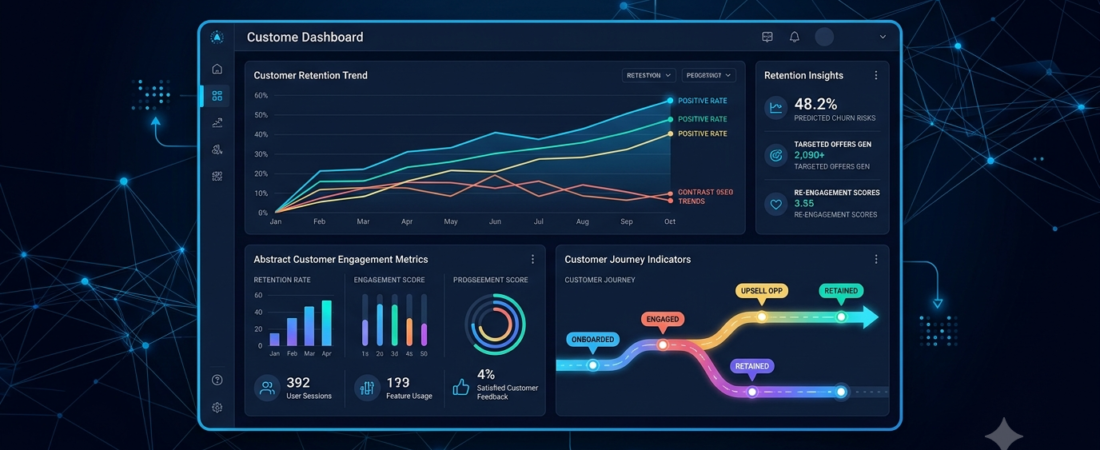
AI retention tools help businesses understand customer behavior, identify customers who may leave, and create more personalized experiences. Instead of focusing only on acquiring new customers, businesses can use AI to strengthen existing relationships and encourage repeat purchases.
Customer retention is important for SaaS companies, online stores, agencies, and small businesses. However, manually analyzing customer activity and deciding when to follow up can be difficult.
Fortunately, AI-powered software can help teams analyze customer data, automate communication, and discover opportunities to improve loyalty. In this guide, we explore seven tools and explain how to choose the right solution for your business.
What Are AI Retention Tools?
AI retention tools are software platforms that use artificial intelligence, automation, customer analytics, or predictive models to help businesses maintain customer relationships.
Depending on the platform, these tools can help businesses:
- Identify customers who have become less active.
- Analyze customer behavior and engagement.
- Personalize emails, messages, and offers.
- Automate follow-up campaigns.
- Identify possible reasons for customer churn.
- Measure customer satisfaction and retention trends.
For example, an online store might use customer purchase history to identify shoppers who have not returned recently. The business could then send a relevant reminder or product recommendation.
However, AI predictions are not always accurate. Businesses should use reliable data and test their campaigns before making major decisions.
7 Best AI Retention Tools to Consider
The following platforms serve different purposes. Some focus on customer relationship management, while others specialize in customer success, messaging, or behavioral analytics.
1. HubSpot — AI-Powered Customer Relationship Management
HubSpot offers CRM, marketing, sales, and customer service capabilities that help businesses manage customer relationships.
Its automation and AI features can support customer retention by helping teams organize customer information, personalize communication, and manage follow-ups.
Best for: Small businesses, marketing teams, and growing companies.
Key benefits:
- Centralizes customer information.
- Supports automated email and follow-up workflows.
- Helps teams track customer interactions.
- Connects marketing, sales, and service activities.
Potential limitation: Some advanced features require paid plans, and businesses may need time to configure workflows properly.
Explore the official platform: https://www.hubspot.com/
2. Gainsight — Customer Success and Retention
Gainsight focuses on customer success, particularly for subscription-based and SaaS businesses. Customer success teams can use customer health information, engagement signals, and workflow capabilities to manage relationships.
These capabilities can help teams recognize accounts that may need additional support before customers decide not to renew.
Best for: SaaS companies and businesses with recurring-revenue models.
Key benefits:
- Helps organize customer success activities.
- Supports customer health monitoring.
- Helps teams manage renewals and customer engagement.
- Provides workflows for customer success processes.
Potential limitation: Its capabilities may be more than a small business needs, and implementation can require planning.
3. Intercom — AI Customer Support and Engagement
Intercom combines customer messaging, support tools, and AI-powered customer service capabilities. Businesses can use these features to answer common questions and provide help across customer interactions.
Better support can contribute to retention because customers are more likely to have a positive experience when their issues are addressed promptly.
Best for: SaaS businesses, online services, and digital products.
Key benefits:
- Supports automated responses to common questions.
- Helps manage customer conversations.
- Offers tools for support teams.
- Can reduce repetitive support work.
Potential limitation: Businesses should review pricing, usage limits, and automation settings before adopting the platform.
Read more about related solutions in our guide to AI customer service tools.
4. Klaviyo — Personalized Customer Marketing
Klaviyo provides marketing automation and customer data capabilities, particularly for ecommerce and direct-to-consumer brands.
Businesses can use customer purchase history and engagement information to create targeted email and messaging campaigns. For instance, a store might send product recommendations based on previous purchases.
Best for: Ecommerce businesses and online retailers.
Key benefits:
- Supports audience segmentation.
- Helps personalize marketing campaigns.
- Automates selected customer communication.
- Provides campaign performance reporting.
Potential limitation: Results depend on the quality of customer data, campaign relevance, and the customer’s communication preferences.
5. Braze — Cross-Channel Customer Engagement
Braze helps businesses coordinate customer engagement across supported messaging channels. Its capabilities can help marketing teams create personalized campaigns based on customer behavior and interactions.
For example, an app company could build a campaign for users who have stopped engaging with a particular feature.
Best for: Larger digital businesses, apps, and brands with multiple customer communication channels.
Key benefits:
- Supports coordinated messaging campaigns.
- Helps personalize customer experiences.
- Provides customer engagement analytics.
- Can support lifecycle marketing strategies.
Potential limitation: Smaller teams may find an enterprise-focused platform complex or costly compared with simpler tools.
6. Mixpanel — Customer Behavior Analytics
Mixpanel focuses on product analytics, allowing teams to understand how people interact with websites and applications.
Although it is not exclusively a customer retention platform, behavioral analytics can help teams identify where users stop engaging, which features they value, and which customer journeys need improvement.
Best for: SaaS businesses, mobile apps, and digital product teams.
Key benefits:
- Tracks product usage events.
- Helps analyze user journeys.
- Supports retention and funnel analysis.
- Helps teams evaluate feature adoption.
Potential limitation: Teams need a suitable tracking setup and should respect applicable privacy requirements.
7. Salesforce — CRM and Customer Relationship Management
Salesforce provides CRM and customer engagement capabilities for businesses managing complex customer relationships. Depending on the products and configuration used, teams can apply automation, analytics, and AI features to support customer service and relationship management.
Best for: Growing and enterprise businesses with more complex sales and service operations.
Key benefits:
- Organizes customer relationship information.
- Supports workflow automation.
- Connects customer-facing business processes.
- Offers reporting and AI capabilities across supported products.
Potential limitation: Costs, setup requirements, and feature availability vary by product and plan.
AI Retention Tools Comparison
| Tool | Best use | Suitable business |
|---|---|---|
| HubSpot | CRM and follow-ups | Small and growing businesses |
| Gainsight | Customer success | SaaS and subscription companies |
| Intercom | Customer support | SaaS and digital services |
| Klaviyo | Personalized campaigns | Ecommerce stores |
| Braze | Cross-channel engagement | Apps and larger brands |
| Mixpanel | Product behavior analytics | SaaS and app teams |
| Salesforce | CRM and service workflows | Growing and enterprise businesses |
This comparison is a starting point rather than a universal ranking. The right platform depends on your business model, budget, data, and existing software.
How AI Retention Tools Help Reduce Customer Churn
Customer churn occurs when customers stop purchasing, using a service, or renewing a subscription. AI can help businesses spot patterns associated with disengagement, but it cannot guarantee that customers will stay.
Here are four practical ways to use retention software.
1. Identify At-Risk Customers
Some platforms can analyze signals such as declining product usage, missed renewals, or reduced engagement. These signals can help teams decide which customers may need attention.
For example, a SaaS company could review accounts whose product usage has fallen significantly and offer helpful onboarding or support.
2. Personalize Customer Communication
AI can help teams adapt messaging to customer interests, behavior, and lifecycle stage. A new customer might receive a getting-started guide, while a returning customer might receive relevant product recommendations.
Personalization should be useful and respectful rather than excessive.
3. Automate Follow-Up Campaigns
Businesses can create workflows that trigger messages after specific events, such as an abandoned cart, an upcoming renewal, or a period of inactivity.
To explore related solutions, read our guide to AI marketing tools.
4. Improve the Customer Experience
Retention data can reveal recurring problems, such as confusing onboarding, missing features, or slow support responses. Businesses can use these insights to improve their products and service processes.
For more business-focused solutions, explore our guide to AI tools for small business.
How to Choose the Right AI Retention Tools
Before selecting a platform, evaluate these important factors.
1. Define your retention goal. Decide whether you want to improve subscription renewals, repeat purchases, product engagement, or customer support.
2. Check integrations. Make sure the platform works with your CRM, ecommerce store, email software, or product analytics system.
3. Review pricing. Compare subscription costs, contact limits, usage-based charges, and implementation expenses.
4. Evaluate automation features. Choose workflows that solve real problems without creating unnecessary messages or complicated processes.
5. Check analytics quality. Look for useful reports, understandable metrics, and reliable customer data.
6. Protect customer privacy. Follow applicable privacy rules, limit unnecessary data collection, and provide appropriate choices for customer communications.
If you are still comparing software, our guide on how to choose AI tools can help you evaluate options more systematically.
Common Mistakes to Avoid
Even capable AI retention tools can produce disappointing results when businesses use them incorrectly.
- Relying entirely on predictions: AI can identify patterns, but human review remains important.
- Sending too many messages: Excessive communication may frustrate customers instead of improving loyalty.
- Using poor-quality data: Incomplete or outdated information can lead to irrelevant campaigns.
- Ignoring customer feedback: Analytics should complement direct feedback, not replace it.
- Tracking the wrong metrics: Measure outcomes that reflect your actual business goals.
Start with one clear retention problem, test a small workflow, and expand only after reviewing the results.
Frequently Asked Questions
What are the best AI retention tools for small businesses?
HubSpot may suit businesses that need CRM and follow-up workflows. Klaviyo can be useful for ecommerce marketing, while Intercom may help businesses that need customer messaging and support. Compare current plans before choosing.
Can AI retention tools predict customer churn?
Some platforms can identify patterns associated with churn and highlight potentially at-risk customers. However, predictions are estimates, not guarantees, and their accuracy depends on the available data.
Are AI retention tools useful for ecommerce?
Yes. Ecommerce businesses can use customer segmentation, personalized campaigns, purchase-history analysis, and automated follow-ups to encourage repeat purchases.
Do small businesses need expensive retention software?
Not necessarily. A small business can start with its existing CRM, email platform, or analytics software. Dedicated retention tools become more useful when customer data and workflows grow more complex.
Which metrics should businesses track?
Useful metrics include customer retention rate, churn rate, repeat purchase rate, subscription renewal rate, customer lifetime value, and engagement. Choose metrics that match your business model.
Conclusion
AI retention tools can help businesses understand customers, personalize communication, automate follow-ups, and identify opportunities to improve customer relationships.
HubSpot may be a practical starting point for CRM-focused teams, Klaviyo can support ecommerce campaigns, and Gainsight may be worth evaluating for SaaS customer success. Meanwhile, Intercom and Mixpanel address different parts of the customer experience.
The best approach is to identify your biggest retention challenge, select a tool that addresses it, and measure the results before expanding your investment.
Want to explore more practical AI software guides? Visit Aiventa Guide to discover tools for marketing, customer service, automation, and business productivity.
Useful Resources
- Official HubSpot website: https://www.hubspot.com/
- Official Gainsight website: https://www.gainsight.com/