
Best AI Customer Feedback Analysis Tools for Businesses
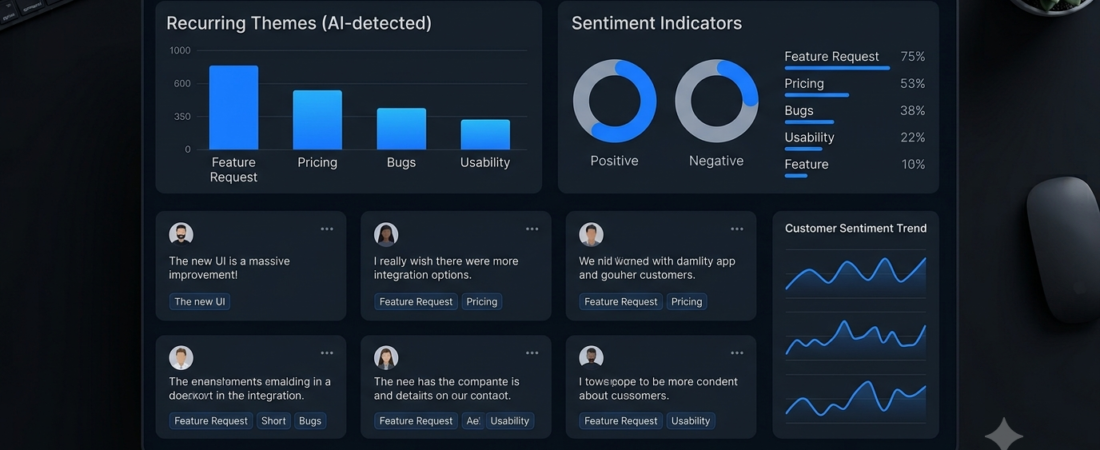
AI customer feedback analysis tools help businesses understand what customers think about their products, services, and overall experiences. Instead of manually reading hundreds of reviews or survey responses, businesses can use AI to identify recurring complaints, positive comments, and common customer requests.
For example, an online store might receive feedback about delivery delays, product quality, packaging, and customer support. An AI analysis tool can help group these comments into themes, making it easier to identify which problems deserve attention.
However, different platforms serve different needs. Some analyze feedback from multiple channels, while others focus on surveys, product reviews, or enterprise customer experience data.
In this guide, we compare five AI customer feedback analysis tools, explain their main uses, and show you how to choose one for your business.
What Are AI Customer Feedback Analysis Tools?
AI customer feedback analysis tools use artificial intelligence and text analysis to organize and interpret customer comments. Depending on the platform, they may identify sentiment, group similar feedback, summarize common issues, and track changes over time.
Businesses can use these tools to analyze information from sources such as:
- Customer surveys and questionnaires.
- Online product reviews.
- Customer support conversations.
- App store reviews and product feedback.
- Open-ended feedback forms.
- Customer experience research.
For instance, if many customers mention that an app is difficult to navigate, a feedback analysis tool may group those comments under a usability theme. A product team can then investigate the issue instead of reading every comment individually.
AI findings are not automatically correct, though. Businesses should review the original comments before making important decisions.
5 Best AI Customer Feedback Analysis Tools
1. Thematic — Best for Finding Patterns in Feedback
Best for: Customer experience teams, researchers, and businesses with large amounts of written feedback.
Thematic specializes in analyzing customer feedback and identifying recurring themes. It can help businesses understand what people are discussing across feedback datasets without relying entirely on manual tagging.
For example, a company could analyze survey comments to identify repeated concerns about pricing, product reliability, or onboarding.
Key features:
- AI-assisted theme discovery.
- Analysis of written customer feedback.
- Sentiment and trend exploration.
- Tools for understanding recurring customer concerns.
Pros:
- Useful for finding patterns across large datasets.
- Helps organize unstructured comments.
- Can support more consistent feedback reporting.
Cons:
- Businesses may need to connect or import feedback from existing sources.
- Suitability and available integrations depend on the current plan.
Verdict: Consider Thematic when your business already collects feedback and needs help understanding the themes hidden inside it.
Website: https://getthematic.com/
2. Chattermill — Best for Multichannel Customer Insights
Best for: Larger businesses analyzing feedback across several customer touchpoints.
Chattermill focuses on customer experience analytics. Its platform is designed to help businesses bring feedback together and understand the topics and experiences that influence customer satisfaction.
For example, a retailer could examine customer survey responses alongside support conversations and reviews to identify recurring problems across the customer journey.
Key features:
- AI-powered feedback categorization.
- Sentiment and topic analysis.
- Insights from supported feedback sources.
- Tools for exploring customer experience trends.
Pros:
- Designed for analyzing feedback at scale.
- Helps connect recurring themes across customer interactions.
- Useful for teams working with multiple feedback channels.
Cons:
- May be more than a small business needs.
- The platform’s value depends partly on the quality and availability of connected data.
Verdict: Chattermill is worth evaluating if your business handles large volumes of feedback across several channels.
Website: https://chattermill.com/
3. Unwrap — Best for Discovering Emerging Issues
Best for: Product and customer experience teams that want to spot recurring issues.
Unwrap focuses on using AI to organize customer feedback by meaning and uncover patterns across sources. This approach can help businesses identify related complaints even when customers describe the same issue using different words.
For example, one customer might say an app is “slow,” while another says it “takes too long to load.” A semantic analysis system may recognize that both comments relate to performance.
Key features:
- AI-assisted feedback grouping.
- Identification of recurring themes.
- Analysis across supported feedback sources.
- Tools for monitoring changes and investigating issues.
Pros:
- Useful for discovering patterns that keyword searches can miss.
- Can help teams prioritize recurring problems.
- Relevant to product improvement workflows.
Cons:
- Businesses should check supported integrations before adopting it.
- Advanced monitoring and workflow features may require a suitable plan.
Verdict: Unwrap is worth exploring if your team wants to find common issues across customer comments rather than rely only on keyword searches.
Website: https://www.unwrap.ai/
4. Qualtrics XM — Best for Enterprise Feedback Programs
Best for: Organizations managing surveys and customer experience research at scale.
Qualtrics XM offers tools for collecting and analyzing experience data. Its text analysis capabilities can help organizations examine open-ended survey responses and identify topics or sentiment patterns.
For example, a company running a customer satisfaction survey could analyze thousands of written responses to understand what customers appreciate and what needs improvement.
Key features:
- Survey and experience data analysis.
- Text analytics for written responses.
- Customer experience reporting.
- Tools for managing broader research programs.
Pros:
- Suitable for established research and feedback workflows.
- Offers a broader experience-management environment.
- Can support structured reporting across large programs.
Cons:
- May be too complex for a small business with limited feedback.
- Pricing, implementation, and feature availability depend on the organization’s needs and plan.
Verdict: Qualtrics XM is worth considering if customer feedback is part of a larger research or experience-management program.
Website: https://www.qualtrics.com/
5. SurveyMonkey — Best for Survey-Based Feedback
Best for: Small businesses, teams, and researchers who collect feedback through surveys.
SurveyMonkey is known for creating and managing surveys. Depending on the product and plan, its analysis features can help users organize responses and interpret feedback.
For example, a small business could survey customers after a purchase and review the responses to understand satisfaction, common complaints, and suggestions for improvement.
Key features:
- Online survey creation.
- Collection of customer responses.
- Reporting and analysis features.
- AI-assisted capabilities in supported workflows.
Pros:
- Useful for gathering structured feedback.
- Suitable for customer satisfaction questionnaires.
- Can help connect feedback collection with analysis.
Cons:
- Analysis capabilities vary by plan and feature.
- It may not offer the same specialized multichannel analysis as dedicated feedback analytics platforms.
Verdict: SurveyMonkey is a sensible starting point if your main challenge is collecting customer feedback through surveys and understanding the responses.
Website: https://www.surveymonkey.com/
Comparison: Which AI Feedback Analysis Tool Should You Choose?
| Tool | Best For | Main Strength |
|---|---|---|
| Thematic | Finding patterns in comments | Theme discovery |
| Chattermill | Multichannel feedback | Customer experience insights |
| Unwrap | Discovering recurring issues | Semantic feedback grouping |
| Qualtrics XM | Enterprise research | Survey and experience analytics |
| SurveyMonkey | Survey-based feedback | Feedback collection and reporting |
This is a use-case comparison, not a controlled test or an independent ranking of accuracy. Features, integrations, and prices can change, so review the official websites before making a decision.
How to Choose the Right AI Feedback Analysis Software
1. Identify Where Your Feedback Comes From
Start by listing your main sources: reviews, surveys, support tickets, social media, or app feedback. Some tools analyze data you already collect, while others also provide ways to gather feedback.
2. Check Sentiment and Theme Analysis
Sentiment analysis estimates whether a comment expresses a positive, negative, or neutral opinion. Theme analysis identifies what the customer is discussing, such as delivery, pricing, reliability, or ease of use.
Both can be helpful, but sentiment alone may hide important details. A customer could praise a product’s quality while complaining about its price.
3. Review Integrations and Data Imports
Check whether the tool supports your existing platforms and file formats. If your feedback is scattered across different systems, importing and connecting the data may be an important part of setup.
4. Compare Cost and Complexity
A small store may only need to review customer survey responses occasionally. A large company may need continuous monitoring, detailed reports, permissions, and integrations.
Choose a tool that fits your actual workload rather than paying for features you are unlikely to use.
5. Protect Customer Information
Customer feedback may contain personal details. Review each provider’s privacy policy, data retention settings, access controls, and applicable data-processing terms before uploading information. Remove unnecessary personal data whenever possible.
Businesses looking to improve customer interactions can also explore our guide to AI customer service tools. For wider business workflows, see AI tools for small business.
How to Analyze Customer Feedback with AI
You can follow this basic workflow with a tool that supports your feedback format.
- Collect feedback: Gather relevant reviews, survey responses, or comments that you have permission to analyze.
- Organize the data: Remove duplicate entries and correct obvious formatting problems.
- Choose an analysis tool: Check its supported file types, integrations, and privacy terms.
- Identify themes: Look for repeated topics such as product quality, pricing, delivery, and usability.
- Review sentiment: Examine whether feedback is positive, negative, or mixed for each theme.
- Check the original comments: Confirm that the AI has interpreted the feedback correctly.
- Take action: Prioritize the most important issues and monitor whether the changes improve customer experiences.
Example Prompt for Customer Feedback Analysis
If your AI tool supports file uploads and analysis, you can try this prompt with a suitable dataset:
“Analyze the customer feedback in this dataset. Group similar comments into themes, summarize positive and negative feedback, and identify recurring concerns. Use only information supported by the comments. Include a few representative examples for each theme, protect personal information, and clearly flag uncertain interpretations. Do not invent statistics or claim that one issue caused another without evidence.”
This prompt can help structure the analysis, but you should still validate its conclusions against the source data.
Frequently Asked Questions
What are AI customer feedback analysis tools?
They are software tools that use AI to organize customer comments, identify recurring topics, and analyze sentiment. Some also support reporting, trend monitoring, and integrations with other business systems.
Can AI analyze Google reviews?
Some tools support review analysis through supported integrations or imported data. Before choosing one, verify whether it can access the specific review source you need and whether the method complies with the platform’s terms.
Is AI sentiment analysis accurate?
It can be useful, but it is not perfect. Sarcasm, mixed opinions, local expressions, and context can lead to incorrect classifications. Review important results before acting on them.
Are AI feedback analysis tools free?
Pricing varies. Some platforms offer limited trials or entry-level plans, while specialized enterprise systems may require a sales consultation. Check current pricing on official websites.
Can small businesses use AI to analyze customer feedback?
Yes. A small business can start with a manageable set of survey responses or customer reviews. Choose a tool that matches your feedback volume, budget, and privacy requirements.
Conclusion
AI customer feedback analysis tools can help businesses turn customer comments into clearer insights. Thematic is worth exploring for theme discovery, Chattermill for multichannel customer experience analysis, Unwrap for recurring issue detection, Qualtrics XM for larger research programs, and SurveyMonkey for survey-based feedback.
Start with a small dataset, verify the analysis, and focus on issues your business can realistically address. The goal is not simply to generate another report; it is to understand customers better and make informed improvements.
Explore more practical AI software guides on Aiventa Guide to discover tools for business, productivity, and customer experience.