Best AI Tools for Inventory Management
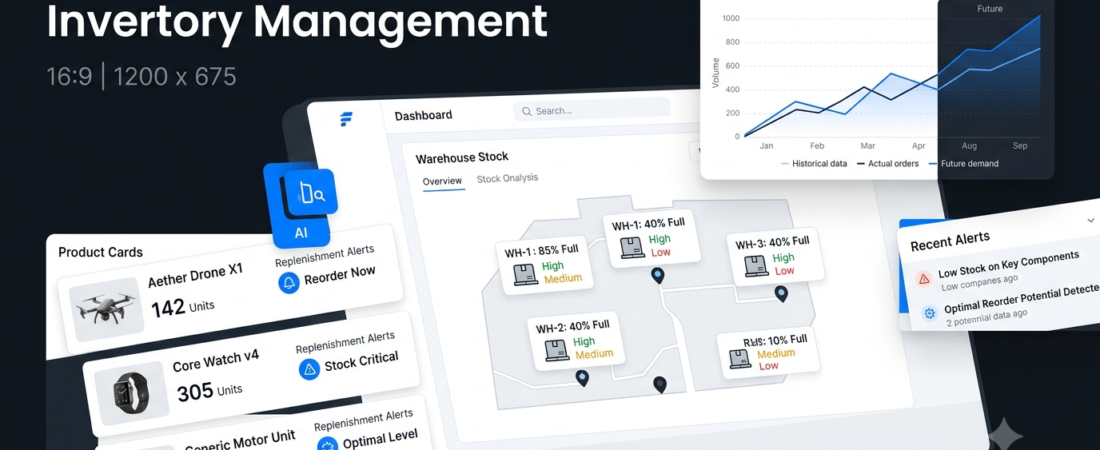
AI tools for inventory management help businesses monitor stock levels, organize product information, and make better-informed replenishment decisions. Depending on the platform, they can also support demand forecasting, order processing, and automated inventory alerts.
For example, an online store may need to identify products that are selling quickly, while a small retailer might want to avoid ordering too much stock before demand changes. Inventory software can help teams understand these patterns and plan accordingly.
However, not every inventory platform uses AI in the same way. Some focus on stock tracking and order management, while others offer demand planning, forecasting, or AI-assisted analytics.
In this guide, we’ll compare seven inventory management tools, explain their main uses, and help you choose a platform that fits your business.
What Are AI Tools for Inventory Management?
AI inventory management tools combine inventory software with capabilities such as forecasting, pattern detection, automation, and data analysis.
Depending on the product, they may help businesses:
- Monitor stock levels across locations.
- Track incoming and outgoing inventory.
- Estimate future product demand.
- Identify items that may need replenishment.
- Organize purchase orders.
- Connect inventory with sales channels.
- Analyze inventory performance.
Important: Not every tool listed below offers AI forecasting in every plan. Some are primarily inventory management systems with automation or integrations. Verify the exact capabilities available before subscribing.
7 Inventory Management Tools to Compare
1. Cin7 — Best for Growing Product Businesses
Cin7 provides inventory and order management solutions for product-based businesses. It can help coordinate stock, sales channels, purchasing, and warehouse workflows.
Key features:
- Inventory and order management
- Stock visibility
- Purchasing workflows
- Sales channel integrations
- Reporting and operational automation
Best for: Growing retailers, wholesalers, and product-based businesses managing inventory across multiple channels.
Potential drawback: Setup and integration requirements can become complex as the business grows. Check which automation and forecasting features are included in your plan.
2. Zoho Inventory — Best for Small Businesses
Zoho Inventory helps businesses manage stock, orders, warehouses, and connected sales workflows. It can be useful for companies that want to organize inventory without building a custom system.
Key features:
- Stock tracking
- Order management
- Warehouse support
- Product and shipment workflows
- Integrations with supported business applications
Best for: Small businesses and online sellers looking for structured inventory and order management.
Potential drawback: Plan limits, integrations, and available automation features vary. Advanced predictive capabilities may require additional tools or workflows.
3. Netstock — Best for Inventory Planning
Netstock focuses on inventory optimization and supply planning. Its planning capabilities can help businesses assess stock requirements and make replenishment decisions using relevant business data.
Key features:
- Inventory planning
- Demand and supply analysis
- Replenishment recommendations
- Stock risk visibility
- Planning reports
Best for: Businesses that need more structured inventory planning and supply chain visibility.
Potential drawback: Forecast quality depends on historical data, product behavior, and the configuration of the planning system.
4. Inventory Planner — Best for E-commerce Forecasting
Inventory Planner focuses on inventory forecasting and replenishment planning for retailers. It can help businesses estimate stock needs and organize purchasing decisions using sales and inventory information.
Key features:
- Inventory forecasting
- Replenishment planning
- Purchasing recommendations
- Sales and stock analysis
- Retail workflow integrations
Best for: Online retailers and product sellers who need help planning purchases.
Potential drawback: Forecasting is only as useful as the underlying data and assumptions. Review compatibility with your e-commerce platform before committing.
5. Odoo Inventory — Best for Connected Business Operations
Odoo provides inventory management as part of a wider suite of business applications. Businesses can connect inventory workflows with sales, purchasing, accounting, and other supported modules.
Key features:
- Warehouse and stock operations
- Inventory movements
- Purchase and sales workflows
- Product tracking
- Integration with other Odoo applications
Best for: Businesses that want inventory management connected to broader operational processes.
Potential drawback: Customization and implementation can require technical assistance. AI capabilities depend on the specific applications, integrations, and configuration used.
6. Fishbowl — Best for Warehouse and Manufacturing Workflows
Fishbowl provides inventory and warehouse management capabilities for product-based businesses, including organizations that need to coordinate inventory with manufacturing or accounting workflows.
Key features:
- Inventory tracking
- Warehouse operations
- Manufacturing-related workflows
- Order and purchasing management
- Business software integrations
Best for: Businesses with more involved warehouse or manufacturing requirements.
Potential drawback: Implementation effort, compatibility, and total costs depend on your existing systems and operational complexity.
7. SAP Integrated Business Planning — Best for Enterprise Planning
SAP Integrated Business Planning supports supply chain planning, including demand planning, inventory planning, and coordination across business functions.
It is designed for organizations that need structured planning across larger or more complex supply chains.
Key features:
- Demand planning
- Inventory optimization
- Supply planning
- Scenario analysis
- Enterprise planning workflows
Best for: Larger businesses managing complex supply chains and multiple planning teams.
Potential drawback: Implementation may require substantial planning, specialist knowledge, and budget. It may be excessive for a small shop with simple stock requirements.
Inventory Management Tools Compared
| Tool | Best use | Main strength |
|---|---|---|
| Cin7 | Multi-channel product businesses | Inventory and order coordination |
| Zoho Inventory | Small businesses | Stock and order management |
| Netstock | Inventory planning | Replenishment and supply planning |
| Inventory Planner | Retail forecasting | Stock and purchasing recommendations |
| Odoo Inventory | Connected operations | Integration with business workflows |
| Fishbowl | Warehouse and manufacturing | Operational inventory management |
| SAP Integrated Business Planning | Enterprise supply chains | Large-scale planning |
This is a use-case comparison rather than a universal ranking. Compare current features, pricing, integrations, and AI capabilities against your actual inventory requirements.
How to Use AI Inventory Management Software
1. Organize Your Product Data
Start with accurate product names, stock quantities, SKU codes, supplier information, and purchasing records.
Incorrect or incomplete inventory data can lead to misleading stock reports and poor replenishment decisions.
2. Connect Sales and Inventory Records
Where supported, connect your store, sales system, purchasing workflow, and warehouse records. This helps maintain a more consistent view of stock across your business.
For related e-commerce workflows, explore our guide to AI tools for small businesses.
3. Review Demand Patterns
Use sales history to identify seasonal changes, fast-moving products, and items with inconsistent demand.
Forecasts should also account for promotions, supplier delays, new products, and other events that may not be represented in historical sales.
4. Set Reorder Rules
Use the platform’s available alerts and replenishment settings to identify products that may need reordering.
Review supplier lead times and safety-stock requirements before relying on automated suggestions.
5. Monitor Inventory Performance
Track useful measures such as stockouts, excess stock, inventory turnover, and order fulfilment performance.
A dashboard can help you identify recurring problems and decide which process needs improvement. See our guide to AI data visualization tools for related reporting ideas.
6. Review Automated Recommendations
Before approving large purchases or major stock changes, check the data and assumptions behind the recommendation. Human review remains especially important when demand is volatile or supply is uncertain.
How to Choose the Best AI Inventory Management Software
Consider Your Business Size
- Small shops: Prioritize simple stock tracking and order management.
- Online stores: Look for e-commerce integrations and multi-channel visibility.
- Wholesalers: Consider purchasing, warehouse, and replenishment workflows.
- Manufacturers: Review component tracking and production-related requirements.
- Large enterprises: Evaluate demand planning, governance, and supply chain integrations.
Check Integration Support
Confirm that the software works with your store, accounting system, shipping workflow, and supplier processes. An impressive feature is less useful if it cannot connect to your existing setup.
Evaluate Forecasting Features
If demand forecasting is important, ask how the tool generates recommendations, which data it uses, and whether users can review the assumptions.
Compare Pricing and Setup Costs
Consider subscription fees, user limits, integration charges, onboarding, and ongoing maintenance. Some systems may require professional implementation.
Review Security and Permissions
Inventory systems may contain supplier details, sales records, and sensitive business information. Check user access controls, data handling, and backup practices.
Benefits of AI Tools for Inventory Management
Better Stock Visibility
Connected inventory records can help teams understand how much stock is available and where it is stored.
More Informed Replenishment
Forecasting and planning features can support purchasing decisions based on sales history and business requirements.
Less Manual Administration
Automation can reduce repetitive updates, order processing, and routine reporting.
Improved Operational Planning
Inventory reports can help businesses identify slow-moving items, stock shortages, and recurring supplier issues.
More Structured Decision-Making
Reliable inventory data makes it easier to compare alternatives and plan purchasing activities.
These benefits are not guaranteed. Results depend on data quality, supplier reliability, demand changes, and how well the software fits your processes.
Frequently Asked Questions
What are the best AI tools for inventory management?
Cin7, Zoho Inventory, Netstock, Inventory Planner, Odoo Inventory, Fishbowl, and SAP Integrated Business Planning are options worth comparing. Their strengths range from basic stock management to enterprise planning.
Can AI predict inventory demand?
Some inventory platforms provide forecasting or planning capabilities that use historical data and other inputs. Forecasts are estimates, so review assumptions and account for unusual events.
Are AI inventory tools suitable for small businesses?
Yes. Small businesses may benefit from better stock visibility, order tracking, and replenishment workflows. Start with the simplest platform that meets your operational needs.
Can inventory software reduce stockouts?
It can help businesses monitor stock and plan replenishment, but it cannot eliminate stockouts. Supplier delays, sudden demand changes, and inaccurate records can still create problems.
Do all inventory management tools include AI?
No. Some focus on traditional inventory tracking and automation, while others provide forecasting or AI-assisted analysis. Confirm the current features of the exact product and subscription.
Conclusion
AI tools for inventory management can help businesses organize stock, coordinate orders, and make more informed purchasing decisions.
Cin7 and Zoho Inventory are worth comparing for inventory operations, Netstock and Inventory Planner for planning workflows, Odoo and Fishbowl for connected operations, and SAP Integrated Business Planning for enterprise supply chains.
Before choosing a platform, review your current stock process, verify the integrations you need, and compare the real cost of implementation. Accurate inventory data and well-designed processes remain essential, even when AI features are available.
Explore more on Aiventa Guide: Read our guides to AI tools for small businesses, AI automation tools, and AI data visualization tools.
Useful Inventory Management Resources
- Zoho Inventory — Explore stock, order, and warehouse management features.
- Odoo — Explore connected inventory and business management applications.