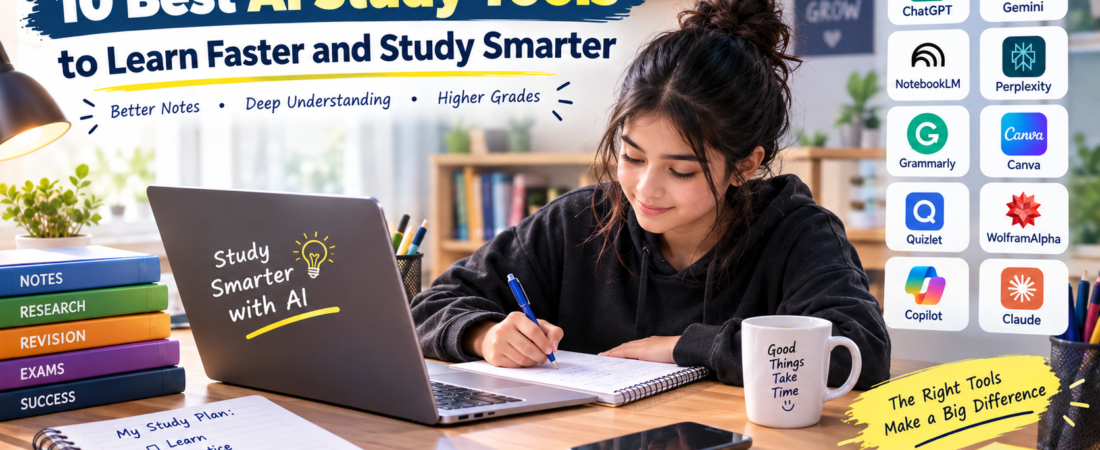
Studying becomes easier when you have the right resources. AI study tools can help students understand difficult concepts, organize notes, create practice questions, research topics, and prepare for exams.
Artificial intelligence should not be viewed as a replacement for studying. Instead, it can work as a personal learning assistant that helps explain confusing topics and makes revision more organized.
For example, a student can provide their notes to an AI tool and ask for practice questions. Another useful approach is asking the tool to explain a difficult topic using simple language and examples.
In this guide, we will look at some of the best AI tools for studying and explain what each one can help you do.
Important: Use AI to improve your understanding rather than simply copying answers. Always verify important academic information with your textbook, teacher, or reliable sources.
What Are AI Study Tools?
AI study tools are applications that use artificial intelligence to support different parts of the learning process.
Depending on the platform, students can use them for:
- Understanding difficult topics
- Creating study notes
- Summarizing information
- Researching subjects
- Creating quizzes
- Making flashcards
- Improving writing
- Solving mathematical problems
- Preparing presentations
- Reviewing study material
The right choice depends on your subject, learning style, and specific goal.
1. ChatGPT — Best Overall AI Study Assistant
ChatGPT is one of the most flexible options for students.
Difficult subjects can be broken into smaller concepts, making them easier to understand. Practice questions can also be generated to test your knowledge after studying a topic.
Another useful approach is asking ChatGPT to act as a tutor. For example, you could write:
“Explain this topic step by step, then give me five questions to test my understanding.”
This method encourages active learning instead of simply reading an answer.
Best for: Explanations, practice questions, brainstorming, revision, and writing.
Official website: https://chatgpt.com/
2. Google Gemini — Great for Learning and Research
Google Gemini can help students understand concepts, research subjects, brainstorm ideas, and organize information.
Its learning-focused features can make difficult subjects easier to explore. Google has also highlighted Guided Learning as a way to help learners work through concepts rather than simply receiving an answer.
Students who already use Google services may also find Gemini convenient for their existing workflow.
Best for: Learning concepts, research, explanations, and Google users.
Official website: https://gemini.google.com/
3. NotebookLM — Best for Notes and PDFs
NotebookLM is particularly useful when your study material already exists in documents.
Class notes, research material, and supported documents can be used as sources for questions and revision. The tool can then help you explore the information contained in those sources.
For example, after adding your study material, you could ask:
“Create 15 revision questions from these notes.”
Google has also highlighted NotebookLM’s usefulness for creating study materials such as quizzes and flashcards from students’ own sources.
Best for: Notes, documents, PDFs, revision, and source-based studying.
Official website: https://notebooklm.google.com/
4. Perplexity — Best for Research
Researching a topic often requires finding information from several sources. Perplexity can make this process more convenient by providing answers along with source references.
A student could use it to explore a historical event, understand a scientific topic, or find additional information for a project.
However, AI-generated information should still be checked. Original sources are especially important when the information will be used in academic work.
Best for: Research, source discovery, and exploring topics.
Official website: https://www.perplexity.ai/
5. Grammarly — Best for Improving Writing
Good writing is important for essays, reports, assignments, and presentations.
Grammarly can identify grammar, spelling, clarity, and style problems. As a result, students can improve their writing while also learning from their mistakes.
Rather than asking an AI system to create an entire assignment, consider using writing tools to improve your own work.
Best for: Grammar, clarity, proofreading, and writing improvement.
Official website: https://www.grammarly.com/
6. Quizlet — Best for Flashcards and Revision
Quizlet is useful for students who enjoy learning through flashcards and practice activities.
Flashcards can be helpful for vocabulary, definitions, formulas, terminology, and other information that needs repeated revision.
Regular practice can make it easier to identify which topics you already understand and which ones need more attention.
Best for: Flashcards, memorization, vocabulary, and revision.
Official website: https://quizlet.com/
7. Canva — Best for Presentations and Visual Learning
Canva can help students create presentations, diagrams, visual notes, and educational graphics.
A complicated subject sometimes becomes easier to remember when information is organized visually. Presentations can also look more professional when concepts are arranged clearly.
Students can use Canva for classroom presentations, projects, revision charts, and other educational materials.
Best for: Presentations, visual notes, diagrams, and projects.
Official website: https://www.canva.com/
8. Wolfram|Alpha — Best for Mathematics
Mathematics often requires more than memorizing information. Understanding calculations and problem-solving methods is equally important.
Wolfram|Alpha can help with mathematical calculations and exploring mathematical concepts.
The best approach is to use it as a learning aid. Try solving the problem yourself first, then use the tool to check your work or understand the calculation.
Best for: Mathematics, calculations, formulas, and technical subjects.
Official website: https://www.wolframalpha.com/
9. Microsoft Copilot — Useful for Everyday Study Tasks
Microsoft Copilot can support students with brainstorming, explanations, writing, and other everyday tasks.
For example, you could use it to create an outline for a presentation before developing the content yourself.
Students who already use Microsoft products may find Copilot particularly convenient.
Best for: Brainstorming, writing, explanations, and Microsoft users.
Official website: https://copilot.microsoft.com/
10. Claude — Great for Detailed Explanations
Claude can be useful when a topic requires a detailed explanation.
A complicated subject can be divided into smaller sections, followed by examples and practice questions. This approach can make large topics feel more manageable.
As with any AI assistant, important information should be reviewed instead of being accepted automatically.
Best for: Detailed explanations, writing, organizing information, and studying complex topics.
Official website: https://claude.ai/
AI Study Tools Comparison
| AI Tool | Best For | Student Use |
|---|---|---|
| ChatGPT | General studying | ⭐⭐⭐⭐⭐ |
| Gemini | Learning and research | ⭐⭐⭐⭐⭐ |
| NotebookLM | Notes and PDFs | ⭐⭐⭐⭐⭐ |
| Perplexity | Research | ⭐⭐⭐⭐ |
| Grammarly | Writing | ⭐⭐⭐⭐ |
| Quizlet | Flashcards | ⭐⭐⭐⭐ |
| Canva | Presentations | ⭐⭐⭐⭐ |
| Wolfram | Alpha | Mathematics |
| Copilot | Everyday tasks | ⭐⭐⭐⭐ |
| Claude | Detailed explanations | ⭐⭐⭐⭐ |
How to Use AI Study Tools Effectively
Having access to AI does not automatically make studying easier. The way you use these tools matters.
Start With Your Own Attempt
Try solving a question or explaining a concept yourself before asking AI for help.
This approach allows you to identify exactly where you are struggling.
Turn Notes Into Practice Questions
Your study material can be converted into questions for revision.
After answering them without assistance, compare your responses with the explanations provided by the AI tool.
Ask for Simple Explanations
When a topic feels confusing, request a beginner-friendly explanation.
You can then ask for a real-world example or a few practice questions.
Use AI for Revision
After completing a chapter, ask an AI tool to create a short quiz based on the topics you studied.
Active recall can make revision more useful than simply reading the same material repeatedly.
Verify Important Information
AI systems can sometimes make mistakes or provide outdated information.
For important academic facts, compare the response with your textbook, teacher’s material, academic sources, or official websites.
Which AI Study Tool Should You Choose?
Different students have different requirements.
ChatGPT is a strong choice for general-purpose studying and explanations.
NotebookLM works particularly well when your main study material consists of notes and documents.
Perplexity can be useful when research and source discovery are the priority.
Grammarly is better suited to students who want to improve their writing.
Quizlet is a practical option for flashcards and revision.
Wolfram|Alpha can be helpful for mathematics and calculations.
There is no need to use every tool. Start with one or two that match your study needs, then expand your toolkit if necessary.
Benefits of Using AI for Studying
AI can provide several advantages when used responsibly.
Faster Explanations
Complex ideas can be explained in simpler language, helping students understand topics more quickly.
Personalized Practice
Practice questions can be adjusted according to the topic or difficulty level.
Better Revision
Notes, quizzes, and flashcards can make revision more structured.
Research Assistance
AI can help you discover useful sources and identify different aspects of a topic.
Writing Support
Grammar and clarity tools can help improve essays, reports, and other academic writing.
What Are the Risks of Using AI for Studying?
AI is useful, but it should not be treated as an unquestionable source.
Incorrect information is one possible problem. AI can sometimes produce confident-sounding answers that are inaccurate.
Overdependence is another concern. If students use AI for every question, they may miss opportunities to develop their own reasoning and problem-solving skills.
Privacy should also be considered. Avoid uploading sensitive personal information or confidential documents to AI platforms.
Finally, always follow your school’s or college’s rules regarding AI use in assignments and exams.
FAQs About AI Study Tools
Are AI study tools free?
Many AI study tools provide free plans or limited free features. Paid plans may offer additional features, higher usage limits, or advanced capabilities.
What is the best AI study tool?
There is no single best option for everyone. ChatGPT is useful for general studying, while NotebookLM is particularly helpful for working with your own study material.
Can AI help with exam preparation?
Yes. AI can help create practice questions, explain concepts, summarize notes, and organize revision. Students should still follow their actual syllabus and study material.
Can AI replace a teacher?
No. AI can support learning, but it cannot fully replace the guidance, feedback, experience, and personal support provided by a teacher.
How can students avoid becoming dependent on AI?
Try answering questions independently first. Afterward, use AI to check your understanding, explain mistakes, or provide additional practice.
Related Aiventa Guide Articles
Continue learning with these related guides from Aiventa Guide:
Best AI Image Generators
https://aiventaguide.com/best-ai-image-generators/
How to Choose the Best AI Tools
https://aiventaguide.com/how-to-choose-ai-tools/
AI Tools for Job Seekers
https://aiventaguide.com/ai-tools-for-job-seekers/
Final Thoughts
The right AI study tools can make learning more organized, interactive, and efficient.
Students can use AI to understand difficult concepts, create practice questions, organize notes, research subjects, and improve their writing.
The most effective approach is to treat AI as a learning assistant rather than a replacement for your own thinking.
Start with a tool that matches your biggest study challenge. With the right workflow, AI can become a useful part of your everyday learning routine.
Affiliate Disclosure
Some links on Aiventa Guide may be affiliate links. If you purchase a product or service through an eligible affiliate link, we may receive a commission at no additional cost to you. We only recommend tools that may be useful to our readers.