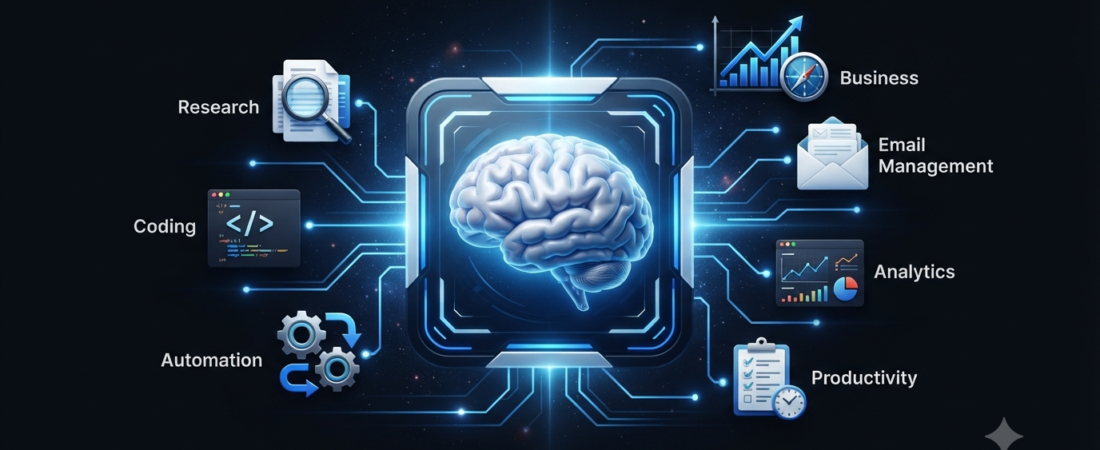
AI is moving beyond simple chatbots. Instead of only answering questions, modern AI agents can research information, work with files, connect to software, automate tasks, and complete multi-step workflows.
That shift is making AI agents one of the most interesting areas of artificial intelligence. Google has introduced more agentic capabilities into Search, while businesses are increasingly exploring AI systems that can reason and take actions instead of simply generating text.
So, what are the best AI agents right now?
In this guide, we compare 12 useful AI agent tools for research, productivity, coding, business automation, and everyday work.
What Is an AI Agent?
An AI agent is a software system that can understand a goal, make decisions, use available tools, and complete multiple steps to achieve that goal.
A normal chatbot might answer:
“What are the best marketing strategies for my business?”
An AI agent can potentially go further by researching information, organizing the results, creating a document, and connecting those results to other software.
Therefore, the biggest difference is action.
AI agents are designed to move from simply generating an answer toward completing a task.
Best AI Agents at a Glance
| AI Agent | Best For | Main Strength |
|---|---|---|
| ChatGPT Work | Complex projects | Multi-step work |
| Google Gemini | Research & Google ecosystem | Search and connected workflows |
| Claude | Research & computer tasks | Reasoning and computer interaction |
| Microsoft Copilot | Business users | Microsoft ecosystem |
| AI by Zapier | Automation | Connecting business apps |
| Relevance AI | Business agents | Custom AI workflows |
| Lindy | Personal automation | Email and repetitive tasks |
| Manus | General task automation | Multi-step execution |
| Perplexity | Research | Web research |
| Cursor | Coding | AI-assisted development |
| Replit | Building apps | AI coding and app creation |
| n8n | Advanced automation | Flexible AI workflows |
1. ChatGPT Work
Best for: Complex projects and multi-step tasks
ChatGPT Work is designed to take a goal and turn it into finished work across apps and files. OpenAI describes it as an agent that can work across apps, create documents, spreadsheets, slides, and web apps, and continue working on complex projects for extended periods.
For example, it can be useful for research-heavy projects where you need several steps completed rather than a single answer.
Best for: researchers, professionals, creators, and teams.
2. Google Gemini
Best for: Research and Google ecosystem workflows
Google is pushing Search and Gemini toward more agentic experiences. Its 2026 Search updates introduced information agents that can monitor information and provide updates, along with additional agentic capabilities.
Because Gemini is closely connected with Google’s ecosystem, it can be particularly useful for people who already work heavily with Google services.
Best for: research, information discovery, and Google users.
3. Claude
Best for: Reasoning and computer-based tasks
Claude is another major AI platform moving toward agent-style capabilities. Anthropic introduced computer-use capabilities that allow Claude, in supported setups, to interact with a computer by viewing screens, clicking, and typing.
That makes Claude interesting for workflows where an AI system needs to interact with software instead of only producing text.
Best for: research, coding, analysis, and advanced workflows.
4. Microsoft Copilot
Best for: Business productivity
Microsoft Copilot is especially useful for people already working inside Microsoft’s ecosystem.
AI-powered workflows can become more valuable when they are connected to documents, communication, meetings, and business processes.
For companies, the advantage is not simply having another chatbot. Instead, the goal is to bring AI assistance closer to everyday work.
Best for: Microsoft 365 users, businesses, and professional teams.
5. AI by Zapier
Best for: Business automation
Zapier has moved its standalone Agents functionality into AI by Zapier, bringing AI reasoning and autonomous actions directly into its automation platform.
This is useful when you want AI to work with other applications.
For example, an AI step can analyze incoming information and then pass structured results to another automation. Zapier also provides controls for approvals and access to thousands of connected apps.
Best for: marketers, businesses, sales teams, and automation workflows.
For more automation ideas, check our guide to AI Automation Tools.
6. Relevance AI
Best for: Custom business AI agents
Relevance AI is designed around building AI agents and multi-step workflows for business use cases.
Instead of using AI only for writing or brainstorming, businesses can build systems around specific processes such as research, sales operations, lead management, and repetitive tasks.
Best for: businesses that want customized AI workflows.
7. Lindy
Best for: Personal and business automation
Lindy focuses on AI assistants that can help automate repetitive tasks.
For example, users can create workflows around email, meetings, scheduling, and other everyday activities.
The biggest advantage is convenience: rather than manually handling every repetitive step, you can create an assistant around a specific workflow.
Best for: entrepreneurs, professionals, and busy teams.
8. Manus
Best for: Multi-step AI tasks
Manus gained attention because it focuses on completing tasks rather than simply answering questions.
A task can involve several stages, such as researching information, organizing results, and creating an output.
That makes it an interesting option for people looking for AI tools that automate tasks.
Best for: research, planning, analysis, and general task execution.
9. Perplexity
Best for: AI-powered research
Perplexity is particularly useful when your goal is research rather than general conversation.
It combines AI-generated answers with web-based information, making it useful for researching topics, comparing information, and discovering sources.
For content creators and students, this can make initial research much faster.
Best for: research, fact discovery, and information gathering.
10. Cursor
Best for: AI coding agents
Cursor is built for software development and provides AI-powered coding capabilities directly inside the development environment.
Developers can use AI to understand code, generate code, make changes, and work through programming tasks.
If you’re interested in this category, our guide on AI Tools for Coding covers more tools for developers.
Best for: developers, programmers, and software projects.
11. Replit
Best for: Building apps with AI
Replit combines coding tools with AI assistance, making it useful for people who want to create applications without handling every coding task manually.
For beginners, this can reduce the technical barrier to experimenting with software ideas.
Meanwhile, experienced developers can use AI assistance to speed up parts of their workflow.
Best for: beginners, developers, and rapid app development.
12. n8n
Best for: Advanced AI automation
n8n is a workflow automation platform that can be used to connect applications, APIs, AI models, and business processes.
It is especially interesting for users who want more control over how their automation works.
Unlike a basic chatbot, an n8n workflow can contain multiple steps, conditions, integrations, and AI-powered decisions.
Best for: technical users, automation builders, and businesses.
How to Choose the Best AI Agent
The best AI agent depends on the task you want to automate.
For research
Choose tools such as Perplexity, Gemini, Claude, or ChatGPT when your main goal is researching information and producing useful results.
For business automation
AI by Zapier, Relevance AI, and n8n are worth considering when you need AI to connect with other applications and workflows.
You can also explore our guides on AI Agents for Business and AI Tools for Small Business.
For coding
Cursor and Replit are strong choices if your main goal is software development.
For a broader comparison, see our guide to AI Tools for Coding.
For productivity
ChatGPT Work, Gemini, Claude, and Lindy can help with research, organization, planning, and repetitive tasks.
You can also read our guide to AI Productivity Tools for more options.
AI Agents vs AI Chatbots
The difference is simple.
A traditional AI chatbot mainly responds to your instructions.
An AI agent can potentially:
- Understand a larger goal
- Break a task into steps
- Use connected tools
- Search or retrieve information
- Make decisions within defined limits
- Perform actions
- Return a completed result
However, agents are not perfect.
They can make mistakes, misunderstand instructions, or perform an incorrect action. Therefore, important workflows should include human review, permissions, and clear limits.
Are AI Agents Worth Using?
For repetitive digital work, they can be extremely useful.
Instead of asking AI to help with every individual step, you can create a workflow where the system handles several connected tasks.
For example, a business might use an AI agent to research leads, organize information, classify prospects, and send the results into a CRM.
Similarly, a content creator could use AI for research, outlining, content organization, and repetitive publishing tasks.
The key is to start small.
Choose one repetitive workflow, test it carefully, and improve it before giving an agent access to more important tasks.
Final Thoughts
The best AI agents are changing how people interact with software.
Instead of opening several applications and manually completing every step, users can increasingly describe a goal and let AI handle parts of the process.
However, the right tool depends on your needs. ChatGPT Work and Gemini are useful for broad AI-assisted work, Claude is strong for advanced reasoning and computer interaction, while AI by Zapier, Relevance AI, and n8n are better suited to automation-heavy workflows.
As agentic AI continues to develop, the biggest opportunity may not be simply using AI to generate content. Instead, it may be using AI to take useful actions and complete real workflows.
Start with one task, keep human oversight where necessary, and expand your automation as you learn what works.
Frequently Asked Questions
What is the best AI agent?
There is no single best AI agent for everyone. ChatGPT Work, Gemini, Claude, AI by Zapier, Relevance AI, and other tools serve different purposes.
What are AI agents used for?
AI agents can be used for research, productivity, coding, business automation, data analysis, customer support, lead management, and repetitive digital tasks.
Are AI agents different from chatbots?
Yes. A chatbot generally focuses on responding to conversations, while an AI agent can be designed to plan tasks, use tools, and perform actions.
Can AI agents automate business tasks?
Yes. Business-focused AI agents can automate parts of workflows such as research, lead qualification, customer support, data processing, and content operations.
Are AI agents safe to use?
They can be useful, but they should be given only the permissions they need. For important actions, human approval and monitoring are recommended.
Can beginners use AI agents?
Yes. Many modern AI agent platforms are designed for non-technical users. Beginners should start with a simple workflow before moving to more advanced automation.
Affiliate Disclosure
Some links on Aiventa Guide may be affiliate links. If you purchase a product or service through an eligible link, we may earn a commission at no additional cost to you. We only recommend tools that we believe may be useful to our readers.