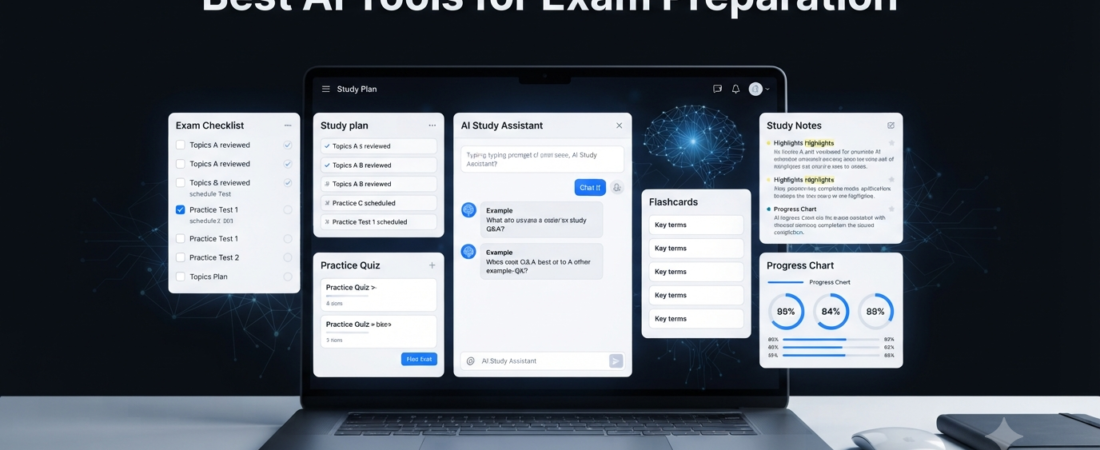
Preparing for an exam can become overwhelming when you have textbooks, notes, PDFs, practice questions, and multiple subjects to manage. Fortunately, AI tools for exam preparation can make the process more organized and interactive.
Instead of using AI only to get quick answers, students can use it to understand difficult topics, create quizzes, generate flashcards, summarize study material, and identify knowledge gaps. For example, Google has introduced AI-powered learning features that can create study guides, interactive quizzes, and practice tests for students.
However, AI should support your learning rather than replace it. The best results usually come when you use AI for explanations and practice while doing the actual thinking and recall yourself.
In this guide, we’ll look at 12 useful AI tools for exam preparation and explain what each one is best for.
What Are AI Tools for Exam Preparation?
AI exam preparation tools are software applications that use artificial intelligence to help students study more efficiently.
Depending on the tool, you can use AI to:
- Explain difficult concepts
- Generate practice questions
- Create flashcards
- Summarize long study material
- Organize notes
- Build study plans
- Analyze mistakes
- Practice quizzes
- Review PDFs
- Improve revision
Moreover, some modern AI learning tools can create interactive study materials from the information you provide.
Therefore, instead of searching for a separate tool for every small task, you can build a simple AI-powered study workflow.
12 Best AI Tools for Exam Preparation
| Tool | Best For | Main Use |
|---|---|---|
| ChatGPT | AI tutoring | Explanations and practice |
| Google Gemini | Study assistance | Questions and learning |
| NotebookLM | Study material | Notes and source-based learning |
| Quizlet | Flashcards | Memorization and practice |
| Knowt | AI flashcards | Notes-to-flashcards |
| Khan Academy | Learning | Guided lessons |
| Perplexity | Research | Research and explanations |
| Notion AI | Organization | Notes and planning |
| RemNote | Spaced repetition | Long-term revision |
| Goodnotes | Digital notes | Note organization |
| Otter.ai | Lecture notes | Transcription and summaries |
| Google AI Search/Canvas | Study guides | Quizzes and study material |
1. ChatGPT — Best for AI Tutoring
ChatGPT can work like an interactive study assistant.
For example, instead of asking for an answer directly, you can ask it to explain a topic step by step. You can also request practice questions and then answer them yourself.
It can help with:
- Topic explanations
- Practice questions
- Revision summaries
- Study plans
- Question analysis
- Writing improvement
- Concept comparisons
Most importantly, try prompts that make you think rather than prompts that simply ask for completed answers.
Best for: Students who want an interactive AI tutor.
Official tool: ChatGPT
2. Google Gemini — Best for General Study Help
Google Gemini can help students understand concepts, generate questions, and organize learning tasks.
Additionally, Google has introduced student-focused AI features that can create practice tests and study guides. These tools can provide feedback after practice, helping students identify areas that need more attention.
For exam preparation, Gemini can be useful for brainstorming questions, explaining concepts, and creating revision material.
Best for: General-purpose studying and practice.
Official tool: Google Gemini
3. Google NotebookLM — Best for Your Own Study Material
NotebookLM is particularly useful when you already have study resources.
You can provide supported source material and use the tool to understand and organize information from those sources.
For example, you could use it with:
- Lecture notes
- Study documents
- Course material
- Research documents
- PDFs
As a result, it can be useful when you want explanations based on specific material rather than a completely general response.
Best for: Studying from your own documents.
Official tool: NotebookLM
4. Quizlet — Best for Flashcards
Quizlet is a popular study platform built around flashcards, quizzes, and other learning activities.
Flashcards can be especially useful when you need to memorize:
- Definitions
- Vocabulary
- Formulas
- Dates
- Key concepts
- Important terms
Instead of repeatedly reading the same chapter, active recall through flashcards can make revision more interactive.
Best for: Memorization and quick revision.
Official tool: Quizlet
5. Knowt — Best for Turning Notes Into Study Material
Knowt focuses heavily on converting study material into useful revision resources.
For instance, students can turn notes into flashcards and practice material instead of creating everything manually.
That can save time when an exam is approaching and you have a large amount of material to review.
Best for: Turning existing notes into revision resources.
Official tool: Knowt
6. Khan Academy — Best for Understanding Concepts
Khan Academy provides structured educational content across many academic subjects.
Its learning approach is useful when you need to build understanding before attempting practice questions.
Rather than simply memorizing an answer, you can first learn the underlying concept and then test your knowledge.
Best for: Concept-based learning and practice.
Official tool: Khan Academy
7. Perplexity — Best for Research
Perplexity can be useful when you need to research a topic and explore information from multiple sources.
For example, you might use it when preparing a project, researching a historical topic, or trying to understand a concept from different perspectives.
However, always verify important academic information with reliable sources.
Best for: Research and source-based exploration.
Official tool: Perplexity
8. Notion AI — Best for Study Organization
Notion can help organize your study material into pages, databases, schedules, and task lists.
With AI features, you can also work with notes and written information more efficiently.
For example, you can create separate pages for each subject and maintain:
- Topics to study
- Revision dates
- Important questions
- Notes
- Assignments
- Exam deadlines
Therefore, Notion can be useful when your biggest problem is organization rather than understanding.
Best for: Organizing your entire study system.
Official tool: Notion AI
9. RemNote — Best for Spaced Repetition
RemNote combines notes, flashcards, and spaced-repetition techniques.
This approach can be helpful when you need to remember information for a longer period instead of only preparing the night before an exam.
Consequently, it can work particularly well for subjects that require repeated recall.
Best for: Long-term revision and memorization.
Official tool: RemNote
10. Goodnotes — Best for Digital Study Notes
Goodnotes is designed around digital note-taking and document organization.
Students can use it to keep handwritten or typed study material together instead of carrying multiple physical notebooks.
In addition, digital notes can make it easier to organize subjects and revisit important sections during revision.
Best for: Digital handwritten and typed notes.
Official tool: Goodnotes
11. Otter.ai — Best for Lecture Transcripts
Otter.ai focuses on transcription and meeting or conversation notes.
For students, transcription can be useful when they need a searchable text version of a lecture or discussion, where appropriate and with permission.
Afterward, you can review the transcript and turn important points into your own study notes.
Best for: Transcribing lectures and discussions.
Official tool: Otter.ai
12. Google AI Search and Canvas — Best for Interactive Study Guides
Google has introduced AI-powered learning experiences that can help students create study guides and interactive quizzes.
You can provide a topic or attach relevant material, then refine the generated learning resource based on the depth or format you need.
This can be particularly useful when you want to turn a broad topic into smaller practice activities.
Best for: Interactive study guides and quizzes.
How to Choose the Best AI Tool for Exam Preparation
You don’t need every AI tool on this list.
Instead, choose tools based on the problem you are trying to solve.
| Your Need | Recommended Type |
|---|---|
| Understand difficult topics | AI tutor |
| Memorize information | Flashcard tool |
| Study from PDFs | Source-based AI |
| Organize your schedule | Study planner |
| Practice questions | Quiz generator |
| Review lectures | Transcription tool |
| Research a topic | AI search tool |
| Long-term revision | Spaced repetition |
For example, a student preparing for a science exam might use NotebookLM for course material, ChatGPT for explanations, and a flashcard platform for revision.
As a result, a small combination of tools can often be more useful than downloading dozens of apps.
How to Use AI for Exam Preparation
Using AI effectively is more important than simply using more AI.
1. Start With Your Syllabus
First, divide your syllabus into subjects and topics.
Then identify which topics are easy, moderate, or difficult for you.
2. Ask AI to Explain Difficult Topics
Instead of asking for a complete answer, ask for a simple explanation.
You can also request examples, comparisons, or step-by-step reasoning.
3. Create Practice Questions
After studying a topic, ask an AI tool to create practice questions.
Then answer them without looking at your notes.
4. Use Active Recall
Active recall means trying to remember information without immediately checking the answer.
Therefore, use flashcards, quizzes, and self-testing instead of only rereading your notes.
5. Review Your Mistakes
Keep a list of questions you answered incorrectly.
Later, return to those topics and try them again.
This approach can help you focus your revision time where it matters most.
AI Notes vs Traditional Revision
| Method | Advantage | Limitation |
|---|---|---|
| Traditional notes | Personal and detailed | Can take more time |
| AI summaries | Very fast | May miss important context |
| AI flashcards | Quick revision | Generated cards need checking |
| AI quizzes | Good for practice | Questions may not match your exam |
| AI tutoring | Interactive explanations | Answers can sometimes be incorrect |
The key point is that AI-generated material should not automatically be treated as correct.
Instead, compare important facts with your textbook, teacher’s material, official syllabus, or another reliable source.
Tips for Getting Better Results From AI Study Tools
Give context. Tell the AI your subject, topic, level, and exam format.
Use your own material. When possible, provide the syllabus or approved study material.
Ask for questions. Testing yourself is usually more useful than repeatedly reading AI explanations.
Verify important information. AI systems can occasionally produce incorrect or incomplete information.
Avoid doing everything with AI. Your goal should be understanding and remembering the material yourself.
Additionally, follow your school’s or college’s rules about acceptable AI use.
FAQs About AI Tools for Exam Preparation
Are AI tools good for exam preparation?
Yes. They can help with explanations, practice questions, flashcards, organization, and revision. However, they work best as study assistants rather than replacements for studying.
What is the best AI tool for exam preparation?
There is no single best tool for everyone. Your choice depends on whether you need tutoring, flashcards, quizzes, notes, research, or study planning.
Can AI create exam questions?
Yes. Many AI tools can generate practice questions from a topic or study material. However, you should review the questions for accuracy and relevance.
Can AI summarize my study notes?
Yes. Several AI tools can summarize documents or notes. Nevertheless, compare important details with your original material.
Are AI study tools free?
Some offer free plans or free features, while others have paid features. Pricing and limits can change, so check the official website before subscribing.
Can AI replace traditional studying?
No. AI can make studying more efficient, but students still need to understand concepts, practice recall, solve problems, and review mistakes.
Related Aiventa Guide Articles
If you want to explore more AI learning tools, check out:
- AI Tools for Students
- AI Tools for Notes
- AI Productivity Tools
- How to Choose the Best AI Tools
Affiliate Disclosure
Some links in this article may become affiliate links in the future. If you purchase a product through an eligible affiliate link, Aiventa Guide may receive a commission at no additional cost to you.
Our recommendations are based on usefulness, features, and suitability for the intended task.
Conclusion
The best AI tools for exam preparation are not necessarily the tools with the most features. Instead, the right choice is the one that helps you understand concepts, practice actively, organize your revision, and identify what you still need to learn.
For example, you might use an AI tutor for explanations, a flashcard tool for memorization, and a quiz generator for practice. Meanwhile, a source-based tool can help you work through your own study material.
Most importantly, don’t let AI do all the thinking for you. Use it to make your study process more interactive while keeping your own understanding and recall at the center.
With the right workflow, AI can become a useful study assistant rather than a shortcut around learning.